Cooking Workshops for Beginners: A Comprehensive Analysis of Foundational Culinary Education
Cooking workshops for beginners serve as vital educational platforms for individuals aiming to transition from basic meal preparation to confident home cooking 1. These programs are designed to demystify culinary processes, providing a supportive environment where novices can learn fundamental techniques such as knife handling, ingredient preparation, and flavor balancing 2. By focusing on practical application, these workshops enable participants to develop autonomy in the kitchen, reducing dependence on pre-packaged meals or external food services 5.
Core Curricula in Entry-Level Culinary Education
Most foundational cooking courses share a common focus on essential techniques that are applicable to a wide range of daily recipes. Curricula typically emphasize knife skills, including the proper dicing of onions and carrots, and safety procedures such as maintaining a clean, organized workspace 1. Instructors often guide students through standard cooking methods, ranging from stovetop techniques like sautéing and pan-searing to more delicate processes like steaming fish or preparing emulsions for sauces 2, 10. Mastery of these basics allows participants to replicate diverse dishes at home with greater consistency and flavor 1.
In addition to technical skill-building, many workshops incorporate structural elements that teach students how to manage their time and resources effectively. Beginners are introduced to multitasking strategies, such as timing the cooking of multiple dish components simultaneously 2. Many programs also incorporate the principles of balanced nutrition, often referencing established frameworks like the USDA MyPlate model, which helps participants understand appropriate food group proportions for healthy, well-rounded meal planning 8.
Workshop Formats and Instructional Methods
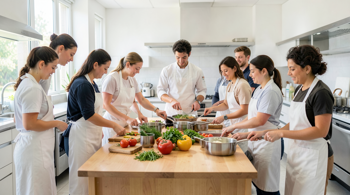
Educational delivery methods for beginner workshops vary significantly, ranging from intimate in-person sessions to structured online courses. Intimate small-group settings, often capped at 8 to 12 guests, allow for personalized instruction and direct access to professional chef-tutors 1, 3. These hands-on environments enable students to receive immediate feedback on their technique, a critical component for those learning to handle equipment or navigate cooking hazards safely 7.
Online platforms offer a different approach, providing flexible access to structured culinary lessons that allow learners to practice at their own pace 4, 6. While these digital environments lack the real-time physical guidance of a classroom, they often use detailed video demonstrations to teach core competencies. Regardless of the format, effective workshops typically conclude with a practical application phase, where students either prepare a full meal to share or take home their finished dishes to consume, reinforcing the lessons learned during the session 2.
Safety and Professional Standards
Safety is a cornerstone of professional culinary instruction, and reputable workshops must prioritize the dissemination of standard food-safety protocols. Participants are typically taught the four pillars of food safety: clean, separate, cook, and chill 9. This involves understanding how to prevent cross-contamination, ensuring ingredients are stored at correct temperatures, and recognizing the visual and thermal indicators of properly cooked proteins 1, 9. By embedding these practices into the curriculum, instructors ensure that students not only gain technical prowess but also cultivate a deep understanding of food hygiene 10.
Furthermore, in-person workshops mandate adherence to physical safety requirements, such as the use of closed-toe, non-slip footwear to protect against burns, slips, and falling kitchen tools 7. Students are often required to sign liability disclosures that acknowledge the inherent risks associated with professional kitchen environments, such as proximity to sharp blades and high-heat surfaces 7. Understanding these professional standards is essential for any beginner, as it ensures that the learning process remains safe and sustainable for all attendees 10.
Integration of Theory and Practice
Advanced beginner courses often bridge the gap between simple recipe following and creative culinary expression. Once basic techniques like vegetable preparation and protein searing are mastered, workshops may move toward the art of balancing flavors and improvising in the kitchen 2, 8. This shift from rigid adherence to recipes toward intuitive cooking is often the final phase of a multi-week course, where students are tasked with designing their own dishes based on established core techniques 8.
Such comprehensive programs may span several weeks to allow for skill retention. A typical progression might involve dedicating individual sessions to specific categories, such as vegetable-based sides in the first week, protein preparation in the second, and sauce-making or plating techniques in the final sessions 8. This progressive learning model mirrors professional culinary training, condensed to suit the needs of non-professional home cooks seeking to improve their daily repertoire 3, 4.
Market Diversity and Specialized Instruction
The culinary education landscape is diverse, featuring options from local community centers to professional institutes. Many cities host specialized workshops, such as those offered by the Institute of Culinary Education or various community-based centers, which cater to recreational learners who have no professional aspirations 3, 5. These courses are distinct from vocational training in that they focus on domestic utility rather than industry-standard efficiency or catering logistics.
When selecting a workshop, it is advisable for prospective participants to review the curriculum to ensure it covers their specific areas of interest or personal learning goals. Some classes may focus heavily on baking and desserts, while others prioritize savory meals, stir-fries, or specific cultural cuisines 2, 3. Examining the instructor's background and the class size can also provide insight into the quality of the experience, as professional chefs bring a depth of industry experience that can translate into valuable real-world tips 3, 5.
Addressing Common Challenges
Transitioning to a cooking-focused lifestyle often involves overcoming psychological barriers, such as the fear of failure or the feeling that cooking is overly complicated 5. Effective beginner workshops actively address these concerns by framing cooking as an iterative, learnable skill rather than an innate talent. By focusing on "real-world" cooking-using accessible ingredients and straightforward equipment-these programs simplify the process and show that confidence is built through repetition and consistent practice 1, 5.
Participants are also encouraged to manage their expectations, understanding that mastery requires time and that errors are a normal part of the learning process. Resources such as bonus online materials, recipe packets, or follow-up knife-skill modules allow students to continue their education after the classroom time has concluded 1, 5. This extended support model is designed to facilitate long-term success, helping individuals maintain their culinary independence long after the final class session 5.
Sources
- Relish Mama: Beginners Cooking Class Melbourne
- Edinburgh Food and Drink Academy: Absolute Beginners 5 Week Course
- CAE: Kitchen Boot Camp for Beginners
- Swinton Cookery School: Beginners Cookery Course
- Mad Cooks: Essentials 3 Week Beginners Course
- Cultivate Kitchen Co: Kitchen Basics 101
- New York Kitchen: Kitchen Confidence 101
- Les Affûtés: Cooking Course Fundamentals
- FoodSafety.gov: 4 Steps to Food Safety
- PLAYTE Kitchen: Fundamental Cooking Skills
Authored by MistyMountainView team