Dance Classes for Beginners: A Practical Guide to Styles, Formats, and First-Class Expectations
Dance Classes for Beginners are commonly designed around step-by-step instruction, welcoming environments, and foundational movement rather than advanced choreography. Current class descriptions show that absolute beginners may attend alone, start without previous experience, and choose formats ranging from weekly workshops to multi-week social dance courses. 1 2
What beginner dance classes usually teach
Introductory courses generally focus on rhythm, posture, basic footwork, body awareness, and simple movement patterns. A Wimbledon ballroom and Latin course describes an eight-week progression that begins with rhythm and elementary steps, introduces simple routines during the middle weeks, and then develops comfort moving around the floor. 1 A Finnish beginner course similarly starts by familiarizing participants with the dance hall, dancing, and their own bodies at a slow pace. 5
- Foundational timing and rhythm
- Basic steps and movement vocabulary
- Coordination, posture, and confidence
- Practice through short combinations rather than complex choreography
Styles available to first-time dancers
Beginner programming spans both social and performance-oriented forms. Broadway Dance Center lists absolute beginner workshops in ballet, theater, jazz, heels, hip-hop, contemporary, tap, and Pilates, with each class lasting 90 minutes and requiring no previous experience for adults aged 18 and over. 2 Other examples include salsa, bachata, and merengue fundamentals, American ballroom, belly dance, and beginner ballet. 3 9
| Style | Typical beginner emphasis |
|---|---|
| Ballroom and Latin | Rhythm, partner connection, basic routines |
| Salsa, bachata, and merengue | Natural movement, timing, and social connection |
| Ballet | Foundational technique and class structure |
| Belly dance | Posture, grace, strength, and fundamental movements |
| Hip-hop, jazz, tap, and contemporary | Style-specific steps and beginner combinations |
Group, private, and drop-in formats
Class structure affects the learning experience as much as dance style. Group sessions can provide a social setting and repeated practice with classmates, while private lessons are tailored to an individual or couple's pace and goals. Arthur Murray Gainesville identifies private beginner lessons, ballroom classes, wedding dance instruction, and group sessions as distinct formats. 7 Fred Astaire's beginner information also describes private instruction for couples and individuals who want lessons paced around personal objectives. 4
Some programs require commitment to a complete series, while others accommodate a single introductory visit. La Peña's four-class series does not offer drop-ins or individual class tickets, whereas Northwest Bellydance Company describes its 101 class as drop-in friendly. 3 9 These differences matter because joining after a series has begun may create a knowledge gap, and missed sessions may not be replaceable under a studio's stated rules.
Partner requirements and social participation
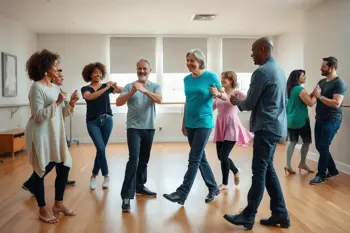
Partner requirements vary considerably by format, but several beginner programs explicitly state that participants may attend without a partner. Wimbledon Dance Academy says many people join alone, and La Peña states that no partner is needed for its salsa, bachata, and merengue series. 1 3 Salsa Dallas describes rotating partners in its beginner program, while its listed beginner schedule includes salsa and bachata classes at a shared Addison location. 6
Partner dance classes may use role-based teaching rather than fixed gender roles. La Peña uses the terms “leaders” and “followers,” presenting them as flexible roles intended to make participation more inclusive. 3 Rotation policies, role expectations, and whether couples remain together can differ by instructor, so these details are practical eligibility questions rather than assumptions. Students seeking a private experience may need a different format from those interested in social practice.
Costs, schedules, and enrollment conditions
Published examples show that pricing depends on location, duration, and class type. La Peña lists a four-class series at $94 plus event fees, while Salsa Dallas lists a four-week beginner program at $79. 3 6 Broadway Dance Center lists a six-week session at $210, and English National Ballet lists beginner ballet at £15 per class or £154 per term. 2 8 These figures are examples from named programs, not a universal market rate.
Scheduling also ranges from short weekly sessions to longer terms. La Peña specifies four Saturday classes from 11:00 a.m. to noon, while Flama lists eight Tuesday sessions of 55 minutes. 3 5 A McLean community-center ballroom course runs from September 14 to November 30, 2026, for adults aged 18 to 99, with one-hour Monday lessons. 10 Enrollment policies can include non-prorating, missed-class restrictions, or administrative fees, making the terms important to review.
What to expect at the first class
First lessons are generally built to reduce uncertainty rather than test ability. Arthur Murray Gainesville describes a welcome, a short conversation about goals, basic movement instruction, and a zero-pressure introduction that does not require special shoes or a partner. 7 Fred Astaire's beginner guidance emphasizes private studio floors, patient instructors, and a pace that does not move faster than the learner. 4
Clothing should allow unrestricted movement, while footwear depends on the style and venue. English National Ballet advises comfortable clothing, barefoot participation or soft ballet shoes, and no street shoes, pointe shoes, jewelry, or socks in its described class setting. 8 A first-time participant should also identify the class level accurately, arrive prepared for warm-up and repetition, and ask about footwear, partner rotation, attendance rules, and progression before the session begins.
Potential barriers and practical safeguards
Common barriers include anxiety about coordination, unfamiliar terminology, physical limitations, and uncertainty about joining alone. Fred Astaire addresses the “two left feet” concern by explaining that coordination develops through repetition, while Flama states that people who find ordinary beginner courses intimidating are welcome in its total-beginner class. 4 5 These statements describe instructional approaches, not guarantees of a particular physical or emotional outcome.
Course selection should account for age rules, accessibility, pace, commitment, and cancellation conditions. Broadway Dance Center's cited workshop is for adults aged 18 and over, whereas English National Ballet states that its beginner ballet class has no upper age limit. 2 8 Program descriptions may change by term, so dates, venue details, fees, instructor assignments, and refund policies require verification with the relevant provider. The main market friction is often not dance ability, but matching the class format to schedule, comfort level, and learning objective.
Sources
- Wimbledon Dance Academy
- Broadway Dance Center
- La Peña Cultural Center
- Fred Astaire Dance Studios, Solana Beach
- Tanssistudio Flama
- Salsa Dallas
- Arthur Murray Dance Centers, Gainesville
- English National Ballet
- Northwest Bellydance Company
- Active.com, McLean Community Center listing
Authored by MistyMountainView team