Budget-friendly outdoor recreation activities for families: A Practical Cost and Planning Guide
Budget-friendly outdoor recreation activities for families often involve a nearby park, a packed meal, borrowed equipment, and one or two hours outside rather than an expensive destination. Research on family outings indicates that a grassy field, bicycle, picnic mat, sandwiches, and sunscreen can create a complete outing close to home, while a weekly hour-long or two-hour routine can make participation easier to maintain. 1 2
Walking, Hiking, and Nature Hunts
Local parks, regional trails, city green spaces, and land-trust paths are among the most accessible settings for family recreation. Trails marked easy are commonly flat and under two miles, while a route with less than 300 feet of elevation gain is more suitable for young children. Trailhead signs and official park websites should be checked for distance, terrain, closures, restrooms, and parking conditions before departure. 1 3
A scavenger hunt gives a simple walk a defined purpose. A list may include a red leaf, acorn, feather, insect, moving water, or ridged bark. Children can observe, draw, or photograph findings instead of removing them, since parks may restrict collecting natural materials. Nature walks also support sensory exploration, communication, observation, and motor development, particularly when adults ask children to describe textures, sounds, colors, and movement. 3 4
Picnics, Games, and Cycling
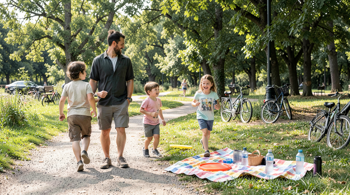
Picnics can extend outdoor time without requiring restaurant spending. Sandwiches, cut fruit, snacks, and refillable water bottles can be prepared at home, then paired with a blanket or mat. Familiar objects such as a frisbee, soft ball, kite, jump rope, or sidewalk chalk can support several activities. Chalk can create hopscotch, while one ball can be used for catch, soccer, or keep-away. 1 2
Cycling adds distance to an outing when families have access to bicycles and helmets. Paved multi-use paths and quiet residential streets may be appropriate, but route selection depends on traffic, surface quality, hills, weather, and local rules. Public parks also commonly contain sports courts, outdoor fitness stations, and seasonal splash pads. Operating dates, supervision policies, and facility closures vary by municipality, so local parks departments remain the relevant authority. 5
Games That Require Limited Equipment
Disc golf is structured recreation that can be played on municipal courses, many of which do not charge an entrance fee. Participation generally requires a disc, and a single disc can be shared while beginners learn throwing and putting techniques. Course difficulty, terrain, signage, and basket condition vary. Families should account for walking distance and uneven ground, especially when younger children or relatives with mobility limitations are participating. 6
Geocaching adds navigation and discovery to a walk through a GPS-based search for hidden containers. The activity is organized through published coordinates and community listings, but families should respect property boundaries, restricted areas, wildlife, and park rules. A phone battery can be a practical limitation, and some locations may be unsuitable for children because of steep slopes, water, roads, or difficult terrain. 8
Camping and Equipment Decisions
Family camping has two distinct financial phases: acquiring equipment and paying for later trips. A complete setup is described as approximately $300 to $600 when purchased new, compared with roughly $100 to $250 when equipment is borrowed or obtained used. After equipment is available, a two-night trip for four is estimated at $80 to $120, while a comparable hotel weekend is reported at $300 to $600 before food. These figures are category estimates, not current quotes. 9
Borrowing or renting equipment can reduce the risk of purchasing gear before a family knows whether camping suits its routines. Used children’s sleeping bags, tents, and other equipment often circulate through thrift stores, gear swaps, and community marketplaces because children outgrow them quickly. Buyers should inspect tent poles, zippers, mold, mildew, stove operation, sleeping pads, rain gear, lighting, insect protection, and first-aid supplies. 5 6
Water Activities and Outdoor Learning
Canoeing and kayaking can provide active recreation on calm lakes, gentle rivers, or other controlled waterways. Beginner-oriented outings commonly emphasize flatwater conditions, simple logistics, snacks, sunscreen, hats, towels, dry clothing, and water-resistant storage for phones and keys. Children may need to ride in tandem arrangements subject to the outfitter’s seating and safety requirements. Conditions, age limits, flotation requirements, and launch rules must be verified locally. 7 8
Water activities have greater environmental and safety consequences than a park picnic. Families should avoid unfamiliar currents, monitor weather, follow posted restrictions, and use required personal flotation equipment. Shore-based alternatives include wading where permitted, observing turtles and birds, or skipping stones in approved areas. These options preserve the nature component without requiring a boat, but water access still involves hazards such as slippery surfaces, changing levels, and exposure to heat or cold. 4
Public Access, Passes, and Eligibility
Public agencies and community institutions can reduce entry barriers, although availability and eligibility vary. The National Park Service’s Every Kid Outdoors initiative provides fourth-grade students with a pass covering entrance to national parks and other federal recreation sites. State parks may offer a lower-fee alternative to national parks, with reported vehicle entry charges commonly ranging from $5 to $15. Families should confirm whether fees apply per vehicle, person, or reservation. 7 11
Public libraries in many U.S. communities lend passes for regional museums, botanical gardens, parks, and other attractions through local library-card programs. National Forests may also permit dispersed camping without the charges associated with developed campgrounds, but those locations usually provide fewer amenities and require greater preparation. Rules concerning fires, sanitation, vehicles, seasonal closures, and group size are governed by the responsible land agency. 9 10
Planning Constraints and Ongoing Responsibilities
The main friction points are often transportation, weather, equipment storage, child stamina, accessibility, and changing operating rules rather than the activity itself. A short drive reduces fuel use and provides an easier return if a child becomes tired, ill, or uncomfortable. Developed campgrounds with restrooms, running water, playgrounds, or beaches may be more manageable for first-time family campers than remote sites, even when remote areas have fewer charges. 5
Outdoor recreation also carries responsibilities that should be treated as part of the planning process. Families need to follow park regulations, leave natural objects undisturbed where required, manage waste, protect food from wildlife, and check fire and weather restrictions. Birdwatching can be conducted with ordinary observation or a free identification app such as Merlin Bird ID, while trail-maintenance volunteering offers structured outdoor participation alongside stewardship. 12 13
Sources
- Hobby Rig, Budget-Friendly Outdoor Activities for Families, https://hobbyrig.com/budget-friendly-outdoor-activities-for-families
- The Professor Dad, Simple Family Outing Ideas That Beat Any Expensive Trip, https://theprofessordad.com/easy-microadventure-ideas-for-families/
- Penniless Parenting, Affordable Outdoor Play Ideas for Families on a Tight Budget, https://pennilessparenting.com/2026/01/affordable-outdoor-play-ideas-for-families-on-a-tight-budget.html
- Pathways.org, 10 Fun & Easy Outdoor Activities for Kids, https://pathways.org/10-fun-easy-outdoor-activities-for-kids
- National Recreation and Park Association, The Importance of Public Parks, https://www.nrpa.org/parks-recreation-magazine/2021/october/the-importance-of-public-parks/
- Professional Disc Golf Association, Introduction to Disc Golf, https://www.pdga.com/introduction
- Kayak Starved Rock, A Family Kayak Day Trip Example Near Chicago, https://kayakstarvedrock.com/family-kayak-day-trip-example-near-chicago/
- Geocaching.com, Play Geocaching, https://www.geocaching.com/play
- Trailstead Guide, Family Camping on a Budget, https://www.trailsteadguide.com/guides/family-camping-on-a-budget
- USDA Forest Service, Camping: Know Before You Go, https://www.fs.usda.gov/visit/know-before-you-go/camping
- National Park Service, Every Kid Outdoors, https://everykidoutdoors.gov/index.htm
- Cornell Lab of Ornithology, Merlin Bird ID, https://merlin.allaboutbirds.org/
- American Hiking Society, Volunteer, https://americanhiking.org/volunteer/
Authored by MistyMountainView team