How to Treat Head Lice at Home: A Clinical Home-Care Guide
How to Treat Head Lice at Home begins with confirming that live lice or viable nits are present, followed by careful combing, correctly used medication, and a scheduled follow-up treatment. Head lice are common, are not caused by poor hygiene, and usually do not transmit disease, although itching and skin irritation can be significant. 1
Confirming an Active Infestation
Diagnosis depends on finding live lice, young lice, or eggs attached to hair close to the scalp. A fine-toothed nit comb should be drawn from the scalp to the ends of wet hair coated with conditioner or another suitable hair product. The hairline, particularly behind the ears, deserves close inspection because viable eggs must remain near the scalp to survive. 2
Nits located more than about one-quarter inch, or 6 millimeters, from the scalp are likely dead or empty. Dandruff and other particles can be confused with eggs, so a magnifying lens or professional confirmation can help. Itching alone does not establish an infestation, and treatment should not be applied simply because a family member reports scratching. 3
Choosing and Applying Treatment
Over-the-counter products containing permethrin or pyrethrins are commonly used for active head lice. Product directions must be followed exactly, including age restrictions, application time, rinsing instructions, and any included combing directions. Only one lice medicine should be used at a time, and applying more than the label allows can increase scalp side effects without improving results. 4
Medication may kill live lice without killing every newly laid egg. For that reason, a second treatment is often needed, commonly 7 to 10 days after the first application, depending on the product instructions. Permethrin directions commonly call for retreatment 9 to 10 days later, while continued nit combing every 2 to 3 days for 2 to 3 weeks can help remove remaining eggs and hatchlings. 5
Using Wet Combing at Home
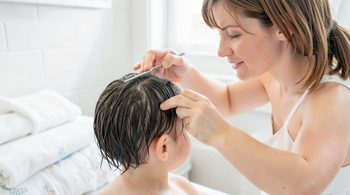
Wet combing is a non-drug method that mechanically removes lice and nits. Hair should be wet and coated with conditioner or another product that allows the comb to move slowly. Divide the hair into manageable sections, place the fine-toothed comb at the scalp, and pull it through to the ends. Wipe or rinse the comb after each pass so removed insects and eggs can be identified and discarded. 6
Combing requires repetition because one session cannot reliably prove that every louse or egg has been removed. A practical schedule is to inspect and comb every 2 to 3 days for 2 to 3 weeks when following the Mayo Clinic approach. Live lice should become less frequent over time; persistent live insects after correctly performed treatment may indicate reinfestation, incorrect application, or resistance. 7
Checking Household Members
Head lice spread mainly through direct head-to-head contact, including contact during play, sports, sleepovers, and close household interaction. Sharing hats, brushes, hair accessories, towels, pillows, or helmets is considered a less common route. Lice do not jump, do not live on pets, and are unrelated to cleanliness or hair-washing habits. 8
Household members should be examined with a nit comb, especially around the scalp and behind the ears. Treatment is generally directed at people with live lice or viable nits close to the scalp rather than people with only old, distant nits. Treating everyone without evidence of active infestation can expose people to unnecessary scalp irritation and does not replace coordinated inspection and follow-up. 9
Managing Bedding and Household Items
Environmental cleaning should be targeted rather than extreme. Wash clothing, pillowcases, towels, and bedding used by the infested person during the 48 hours before treatment, then use a hot washing and high-heat drying cycle when the item permits. Vacuuming floors, carpets, furniture, and car seats can remove hairs or lice that have fallen away from the scalp. 10
Head lice depend on a human scalp for regular blood meals and generally cannot survive away from a person for longer than about 48 hours. Nonwashable items can therefore be isolated in a sealed plastic bag for two weeks when practical. Pesticide sprays, widespread fumigation, and extensive furniture disposal are not necessary and may create avoidable exposure risks. 11
Risks, Treatment Failure, and Medical Advice
Common product-related effects include scalp itching and mild burning that may continue for several days. Gasoline, kerosene, and similar flammable substances should not be used. Tea tree oil, lavender oil, olive oil, mayonnaise, and comparable remedies may be inconsistent or irritate the scalp, and none can reliably guarantee complete removal in one day. 12
Medical advice is appropriate when the scalp develops signs of infection, irritation is severe, a very young child requires treatment, medication reaches the eyes, or live lice remain after correctly following the product schedule. Repeated failure can reflect pyrethroid resistance, which has been reported widely, or reinfestation from an untreated close contact. Prescription options may be considered by a licensed clinician after confirming active lice. 13
Sources
- Johns Hopkins Medicine, No-Panic Guide to Head Lice Treatment
- Mayo Clinic, Head Lice: Diagnosis and Treatment
- Mayo Clinic, Head Lice: Diagnosis and Treatment
- Mayo Clinic, Head Lice: Diagnosis and Treatment
- Mayo Clinic, Head Lice: Diagnosis and Treatment
- Mayo Clinic, Head Lice: Diagnosis and Treatment
- Mayo Clinic, Head Lice: Diagnosis and Treatment
- Scripps Health, How to Get Rid of Head Lice
- National Association of School Nurses, Head Lice Guidance
- American Academy of Dermatology, Head Lice Treatment
- KidsHealth, Head Lice
- Acibadem Hospitals Group, How to Get Rid of Lice Naturally in One Day
- TeleDirectMD, Head Lice Treatment Guide
Authored by MistyMountainView team