Understand glaucoma treatment options: Clinical approaches for intraocular pressure management
The Clinical Objective of Glaucoma Management
Glaucoma represents a group of progressive eye conditions characterized by damage to the optic nerve, frequently associated with elevated intraocular pressure (IOP) 6. Because this nerve damage is irreversible, the primary objective of any medical intervention is to lower IOP to a target level that prevents further vision loss 3, 8. Treatment is a lifelong commitment, as the disease is chronic and necessitates ongoing monitoring to ensure that the established target pressure is maintained 5, 10. Specialists determine this target pressure based on individual risk factors, including the baseline IOP, the severity of existing optic nerve damage, family history, and age 3, 6.
Clinical management follows a stepwise approach, typically beginning with the least invasive therapies and progressing to more complex interventions only when necessary 3. Established risk factors that guide these treatment decisions include Black race or Latino/Hispanic ethnicity, diabetes mellitus, thinner central cornea, disc hemorrhage, and lower ocular perfusion pressure 1. The selection of a specific therapy depends on the patient's ability to adhere to a regimen, their medication tolerance, and the specific type and stage of the glaucoma 6.
Medicated Eye Drops as Primary Therapy
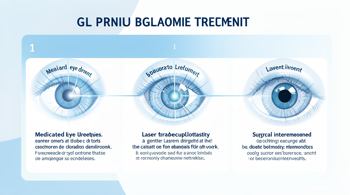
For many patients, prescription eye drops remain the initial line of defense in managing glaucoma 3, 9. These medications function by either reducing the amount of aqueous humor produced by the eye or by enhancing the efficiency of the eye’s natural drainage system 3, 5. Common pharmacological classes used for this purpose include prostaglandin analogs, which are often considered a cornerstone of medical therapy, alongside beta-blockers, alpha-agonists, and carbonic anhydrase inhibitors 4, 5.
Adherence to the prescribed regimen is the most critical component of medical therapy 5. Research indicates that many patients struggle with consistent administration, and failure to use drops as directed can lead to pressure spikes and further optic nerve damage 6, 7. To improve compliance, medical innovations now include fixed combinations and sustained-release implants that reduce the daily burden of multiple administrations 4.
Laser Procedures in Modern Glaucoma Care
Laser therapy has increasingly shifted toward becoming a first-line treatment option, offering a drop-free alternative for patients with early to moderate primary open-angle glaucoma 2, 7. Selective Laser Trabeculoplasty (SLT) is a common, quick, in-office procedure that uses a focused light beam to target the trabecular meshwork 3, 5. By stimulating this drainage system, SLT facilitates improved fluid outflow, thereby reducing IOP 3, 5.
Recent advancements have introduced direct selective laser trabeculoplasty (DSLT) as a further evolution of this technology 7. Laser treatments offer the distinct advantage of meaningful pressure reduction with minimal recovery time, often allowing patients to return to their normal activities immediately 3, 5. While effective, the success of laser intervention can be limited in advanced stages of the disease, necessitating a transition to surgical alternatives when pressure control cannot be achieved 4.
Surgical Interventions for Advanced Disease
When medication and laser therapies prove insufficient to halt disease progression or maintain safe pressure levels, surgeons may recommend incisional procedures 3, 8. Minimally invasive glaucoma surgery (MIGS) has gained traction as a safer alternative to traditional surgical methods, particularly when performed in conjunction with cataract extraction 4, 9. These procedures typically involve the insertion of tiny implants or the creation of micro-channels to improve fluid drainage 8, 9.
Traditional drainage surgeries, such as trabeculectomy or the placement of tube shunts, remain the standard for more advanced cases 6, 9. Unlike laser therapy, these procedures involve creating a surgical opening in the sclera or the internal drainage system of the eye 5. While more invasive, these surgeries are crucial for preserving sight when other methods fail to adequately manage high intraocular pressure 3.
Emergency Management of Angle-Closure Glaucoma
A distinction must be made between primary open-angle glaucoma and acute angle-closure glaucoma, the latter of which constitutes a medical emergency 8. In acute angle-closure cases, the drainage of aqueous humor is completely blocked, leading to a rapid and dangerous spike in intraocular pressure 8, 10. This clinical presentation requires immediate professional intervention to rapidly lower pressure and prevent permanent vision loss 10.
| Treatment Category | Primary Mechanism | Typical Application |
|---|---|---|
| Medicated Drops | Reduce fluid production or increase outflow | First-line, chronic maintenance |
| Laser (SLT/DSLT) | Stimulate drainage tissue | First or second-line, drop-free |
| MIGS | Tiny implants/micro-channels | Low-risk surgery, often with cataract |
| Incisional Surgery | Create new drainage paths | Advanced/uncontrolled disease |
Future Directions in Personalized Care
Ongoing research continues to evaluate strategies for personalized glaucoma management, including emerging therapies in neuroprotection and vascular modulation 4. Clinical studies are exploring the role of caspase inhibition and novel drug delivery systems to improve outcomes in diverse patient populations 4. As the field evolves, the focus remains on early detection and timely intervention to address systemic gaps in screening that often lead to delayed diagnosis 4, 6.
Managing glaucoma is a dynamic process that requires the patient and healthcare provider to work in tandem. Because glaucoma is characterized by asymptomatic progression in its early stages, routine check-ups are vital for tracking the stability of the optic nerve and the effectiveness of current treatment protocols 6. Through a combination of pharmacological, laser, and surgical approaches, many patients are able to successfully protect their remaining vision and maintain their quality of life 5.
Sources
- American Academy of Ophthalmology - Primary Open-Angle Glaucoma PPP 2025
- University of Utah Health - How Modern Glaucoma Treatment Can Protect Your Vision Long Term
- Greenwich Eye - Glaucoma Treatment Options: Drops, Laser and Surgery
- Springer Nature Link - New trends in the treatment of open-angle glaucoma: a critical review
- Glaucoma Research Foundation - Glaucoma Treatments, Surgeries, And Costs
- Ubie Doctor's Note - Glaucoma: How Doctors Choose Between Eye Drops, Laser, and Surgery
- American Academy of Ophthalmology - SLT and DSLT Laser Surgeries for Glaucoma
- Ophthalmology Advisor - Glaucoma Surgery
- Eye Surgery Clinic UK - Glaucoma Treatment Options 2026: Drops vs SLT vs MIGS Surgery
- Liv Hospital - Glaucoma Medical Therapy
Authored by MistyMountainView team