Understanding hospital specialties and service lines: A Practical Guide to Clinical Organization
Understanding hospital specialties and service lines begins with a distinction that affects communication, patient flow, bed management, and data reporting: a specialty describes what a provider is trained to do, while a service line describes an organized group of related clinical services. These terms may overlap in everyday hospital language, but they are not interchangeable. 1
What a hospital specialty means
A medical specialty is a branch of practice focused on a defined group of patients, diseases, skills, or clinical approaches. Examples include cardiology, oncology, orthopedics, neurology, pediatrics, pathology, and family medicine. Physician specialization generally follows foundational medical education and additional residency or fellowship training, although the structure and recognition of specialties varies by country. 6
Specialties can be organized along several dimensions. Some are organ-based, such as cardiology or gastroenterology; others focus on age groups, such as pediatrics or geriatrics; and others are defined by techniques or treatment settings, such as radiology, anesthesiology, emergency medicine, or rehabilitation medicine. Subspecialties represent further training within a broader field, including cardiology within internal medicine or neonatology within pediatrics. 1
What a hospital service line means
A hospital service line is a coordinated set of medical services, procedures, staff, facilities, and support functions organized around a condition, procedure, patient population, or care pathway. Cardiology, oncology, neurology, and orthopedics are common examples, but a service line may also include emergency care, critical care, imaging, rehabilitation, palliative care, or ambulatory services. 2
Unlike a single specialty, a service line can bring together several disciplines. Cancer care, for example, may require medical oncology, radiation oncology, surgery, pathology, radiology, nursing, rehabilitation, and supportive care. The service-line model is intended to coordinate care across departments rather than leave each department operating as an isolated unit. 3
How specialties and service lines differ
The clearest distinction is that specialty is primarily a professional or clinical classification, whereas service line is an organizational and operational classification. A cardiologist belongs to a specialty, but a heart-care service line may include cardiology, cardiac surgery, catheterization laboratories, imaging, intensive care, rehabilitation, scheduling, nursing, and financial or quality-management functions.
Hospitals may use different naming conventions for similar structures. One organization might call cancer care an oncology department, another might call it a cancer institute, and a third might manage it as an enterprise service line spanning multiple hospitals. These labels do not necessarily indicate identical services, staffing, or clinical capability. Service lines increasingly support shared accountability for quality, operations, investment, patient experience, and care coordination. 3
Departments, units, locations, and levels of care
Department, unit, location, and level of care describe different aspects of hospital organization. A department may represent a clinical or administrative function, such as radiology or pharmacy. A unit is often a physical care area, such as an intensive care unit, neonatal intensive care unit, or medical-surgical floor. Location identifies where care occurs, while nursing level of care describes monitoring and staffing intensity. 1
| Term | What it primarily describes |
|---|---|
| Specialty | Provider training and clinical discipline |
| Service line | Coordinated services organized around care needs |
| Department | Hospital functional or clinical division |
| Unit | Physical area where patients receive care |
| Level of care | Required monitoring, staffing, and clinical intensity |
| Location | Site or setting where services are delivered |
These distinctions matter because a patient may remain under one specialty while moving between locations or levels of care. For example, a surgical patient could receive emergency evaluation, operating-room care, intensive monitoring, inpatient recovery, and outpatient rehabilitation without changing the underlying clinical pathway.
Common hospital service categories
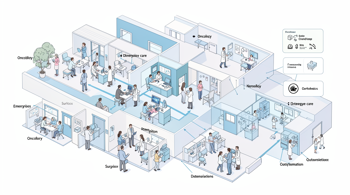
Hospital care is commonly divided into inpatient, outpatient, emergency, diagnostic, procedural, rehabilitation, and post-acute services. Inpatient care involves an admission and hospital stay, while outpatient care is provided without an overnight hospital stay. Emergency departments provide rapid assessment and stabilization, and diagnostic services such as laboratory medicine and imaging support many specialties at once. 10
Large hospitals may operate specialized units including intensive care, progressive care, neonatal intensive care, pediatric intensive care, coronary care, stroke, burn, or trauma services. Other organizations may offer a narrower range, particularly when they serve rural populations or operate as smaller community facilities. A service line can therefore exist at different scales, from one hospital program to an enterprise-wide structure across multiple sites. 2
How hospitals manage performance and patient choice
Service lines are used not only to group clinical activity but also to align strategy, operations, investment, and accountability. Hospitals may assess a service line using clinical outcomes, patient experience, access, staffing, procedure volume, cost, referral patterns, and community need. Healthcare leaders may expand, reduce, or redesign a service offering when performance, technology, workforce conditions, or local demand changes. 4
Patients evaluating hospitals should avoid assuming that a specialty name alone proves the availability of every related service. Capabilities vary by facility size, location, teaching status, staffing, equipment, and role within a health system. Quality and safety information can be reviewed through Medicare Care Compare, which includes measures related to patient experience, safety, readmissions, and outcomes. Accreditation indicates that an organization is assessed against defined quality and safety standards, but it does not mean every specialty or service line is available. 11 12
Regulation, access, and practical limitations
Emergency access has a distinct regulatory framework. Under EMTALA, Medicare-participating hospitals with dedicated emergency departments must provide an appropriate medical screening examination and, when an emergency medical condition is identified, stabilizing treatment or an appropriate transfer. This requirement concerns emergency evaluation and stabilization, not a guarantee that the hospital provides every specialty or definitive procedure. 13
Service-line planning also faces practical friction, including workforce constraints, changing technology, financial pressure, fragmented data, and coordination challenges across multiple sites. Smaller rural hospitals may provide fewer highly specialized services than academic or tertiary centers, while referrals and transfers may be necessary for complex care. Understanding these limitations helps distinguish a hospital's advertised organizational label from the services actually available at a particular location. 14
Sources
- DirkMD, “Difference between Specialty, Service, Level-of-Care, and Location?”
- ShunHospital, “Understanding Hospital Service Lines: A Comprehensive Guide”
- Vizient, “Reinventing service lines: a platform for performance”
- HFMA, “Rethinking Service Lines: Expand, Evolve, or Exit?”
- Sutter Health, “Service Line Fact Sheets”
- Wikipedia, “Medical specialty”
- CostFlex, “How to Classify Patients within Service Lines”
- CareRev, “Hospital Departments Explained”
- Centers for Medicare & Medicaid Services, “Emergency Medical Treatment & Labor Act”
- MedlinePlus, “Outpatient Care”
- Medicare.gov, “Care Compare”
- The Joint Commission, “Accreditation”
- Centers for Medicare & Medicaid Services, “Emergency Medical Treatment & Labor Act”
- Health Resources and Services Administration, “Critical Access Hospitals”
Authored by MistyMountainView team