Simple home remedies for restful sleep: Evidence, routines, and safety considerations
Simple home remedies for restful sleep can include a calming bedtime routine, reduced evening stimulation, daylight exposure, and adjustments to the bedroom. These measures may support sleep quality, but persistent insomnia or symptoms such as breathing pauses require medical evaluation rather than continued experimentation with household remedies.
Why restful sleep matters
Poor sleep quality affects more than next-day energy. Johns Hopkins Medicine reports that disturbed sleep can impair memory, concentration, and mood, while also increasing the risk associated with depression, obesity, type 2 diabetes, heart disease, and high blood pressure. The same source notes that more than 60 million Americans experience poor sleep quality, making sleep difficulty a widespread health concern rather than an isolated inconvenience. 1
Sleep needs and patterns vary, but the health impact of insufficient rest is consistently important. UnitedHealthcare reports that adults are generally advised to obtain at least seven hours per night, while more than one-third of U.S. adults report sleeping below that level in a typical 24-hour period. Sleep supports alertness, recovery, mood regulation, learning, and immune function, so remedies are most useful when they reinforce regular sleep habits. 6
Build a consistent sleep schedule
Going to bed and waking up at approximately the same times each day gives the body repeated timing cues. Cleveland Clinic describes sleep hygiene as preparation and planning that protect sleep, while noting that healthy habits can make it easier to relax and fall asleep. A regular schedule is therefore a foundational home measure, especially when maintained across weekdays and weekends instead of changing substantially from night to night. 2
A predictable wind-down period can help separate daytime activity from sleep. Acibadem’s review identifies regular sleep routines and behavioral strategies as among the more reliable non-drug approaches for ongoing insomnia, while cognitive behavioral therapy for insomnia has the strongest support among non-drug treatments. A home routine may include quiet reading, gentle stretching, or subdued lighting, but it should not be presented as a guaranteed treatment for chronic insomnia. 3
Use light and the bedroom environment strategically
Daytime light exposure can influence the body’s internal timing system. A report from USA Today describes morning outdoor light as a cue for the master clock and notes that exposure shortly after waking may help establish the timing of sleepiness later in the day. This makes a morning walk or time outdoors a potentially useful habit, although weather, work schedules, and medical conditions can affect how practical it is for an individual. 4
Evening lighting should be calmer and less intense than daytime lighting. Michigan Public’s report on sleep rituals recommends dimming household lights to support the body’s transition toward melatonin release, and it describes environmental adjustments as part of a broader wind-down routine. A bedroom that is dark, quiet, and physically comfortable may reduce distractions, but environmental changes cannot correct sleep disruption caused by pain, medication effects, breathing disorders, or severe anxiety. 7
Consider calming drinks carefully
Johns Hopkins Medicine identifies warm milk, chamomile tea, and tart cherry juice as drinks that some patients try for sleep difficulty. The source also emphasizes that scientific evidence is limited for these beverages, although they may be reasonable options for people seeking a simple nighttime ritual. Chamomile tea does not contain caffeine, while tart cherry juice may support melatonin production, but neither should be treated as a proven cure for insomnia. 1
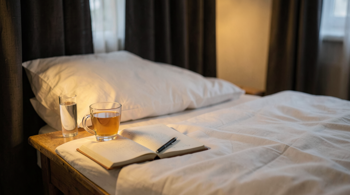
Timing and personal tolerance remain important. Evening alcohol is not a suitable sleep remedy because it can interfere with sleep, and caffeinated drinks may increase alertness when consumed late in the day. Large or uncomfortable meals close to bedtime may also disturb rest. Herbal products can create additional concerns because “natural” does not automatically mean safe, particularly for people taking medicines, managing chronic conditions, or experiencing pregnancy-related health considerations. 3
Try a deliberate relaxation ritual
Relaxation practices can reduce the mental activation that keeps a person alert at bedtime. Michigan Public reports that calming hobbies, meditation, self-care activities, and an evening walk may form part of a wind-down ritual. Keeping a notebook nearby to record stressors can also help move unresolved thoughts out of the immediate bedtime process. The purpose is not to force sleep, but to create repeated signals that the day is ending. 7
Sleep anxiety can become self-reinforcing when concern about having a bad night increases alertness. A TODAY report describes a physician-recommended gratitude exercise involving three positive events from the day as one way to redirect anxious attention before sleep. This technique is a coping strategy, not a medical treatment, and its usefulness may vary. Persistent anxiety, depression symptoms, or daytime impairment should be discussed with a qualified clinician rather than managed solely through bedtime rituals. 8
Manage daytime habits and expectations
Sleep preparation begins well before the bedroom. The New York Times reports that morning sunlight and other daytime choices can affect nighttime rest, reinforcing the idea that sleep is shaped by a full daily pattern rather than only by the final minutes before bed. Light physical activity during the day may support sleep quality, while strenuous activity immediately before bed can be poorly timed for some people. Individual responses should guide adjustments. 8
Home remedies should be assessed by consistency, safety, and measurable effect. A person can track bedtime, wake time, nighttime awakenings, caffeine or alcohol intake, and daytime sleepiness to identify patterns without assuming that every difficult night signals a serious disorder. Loud snoring, breathing pauses, severe daytime sleepiness, persistent sleep problems, or symptoms of anxiety or depression are warning signs for professional assessment. Supplements such as melatonin also have narrower uses, including jet lag and certain circadian timing problems, rather than all forms of sleeplessness. 3
What to avoid and when to seek help
Several popular approaches have limitations. Alcohol can disrupt sleep, herbal remedies such as valerian and chamomile have mixed or limited evidence, and products marketed as natural may still cause side effects or interact with medicines. A calming tea or scent may serve as a personal relaxation cue, but it should not replace evaluation when sleep loss is persistent. Claims that a single food, drink, oil, or supplement will reliably produce restful sleep are not supported by the supplied evidence. 3
The practical standard is whether a habit is safe, repeatable, and associated with better functioning over time. Behavioral treatment, consistent scheduling, light management, and a quiet sleep environment have a stronger overall rationale than relying on an unverified remedy. If sleep difficulty continues despite routine changes, or if breathing-related symptoms and serious daytime effects appear, medical assessment is appropriate. These symptoms can indicate an underlying sleep or mental health condition requiring targeted care. 3
Sources
- Johns Hopkins Medicine, “Natural Sleep Aids: Home Remedies to Help You Sleep,” https://www.hopkinsmedicine.org/health/wellness-and-prevention/natural-sleep-aids-home-remedies-to-help-you-sleep
- Cleveland Clinic, “Sleep Hygiene: 8 Tips To Improve Sleep,” https://health.clevelandclinic.org/sleep-hygiene
- Acibadem Hospitals Group, “Natural Sleep Aid: What Works, What Does Not, and Safety Notes,” https://acibademinternational.com/health-library/natural-sleep-aid-what-works-what-does-not-and-safety-notes/
- USA Today, “How to fall asleep: Science-backed tips for better rest,” https://www.usatoday.com/story/life/health-wellness/2026/03/01/how-to-fall-asleep/88752448007/
- Oprah Daily, “3 Science-Backed Ways to Sleep Better Tonight, According to Doctors,” https://www.oprahdaily.com/life/health/a70791885/how-to-sleep-better-tonight/
- UnitedHealthcare, “How to improve sleep and lead a healthier life,” https://www.uhc.com/news-articles/healthy-living/sleep-tips
- Michigan Public, “Too hyped up to sleep? Rituals to calm your body and mind before bed,” https://www.michiganpublic.org/2026-03-07/too-hyped-up-to-sleep-rituals-to-calm-your-body-and-mind-before-bed
- The New York Times, “6 Daytime Habits for Better Sleep,” https://www.nytimes.com/2026/03/09/well/better-sleep-tips.html
Authored by MistyMountainView team