Best hearing aids for seniors 2026: An evidence-based guide to features, fit, and coverage
The search for the best hearing aids for seniors 2026 centers on a practical question: which device matches the wearer’s hearing-loss pattern, daily environment, dexterity, connectivity needs, and access to professional support? Current research describes a market divided between prescription instruments fitted by hearing professionals and FDA-regulated over-the-counter devices intended for adults with perceived mild-to-moderate loss. 1 2
How the 2026 hearing-aid market is organized
Prescription hearing aids remain the principal option for complex, severe, or rapidly changing hearing needs because a licensed professional can test hearing, select appropriate power, adjust sound processing, and provide follow-up care. Leading manufacturers identified in the research include Oticon, Phonak, Starkey, ReSound, and Widex. OTC hearing aids, established under the FDA’s October 17, 2022, final rule, are intended for adults 18 and older who perceive mild-to-moderate hearing loss and can select or adjust their own amplification. 2 4
| Category | Typical role | Important limitation |
|---|---|---|
| Prescription | Clinically fitted hearing loss, including more complex needs | Usually requires professional appointments and higher expenditure |
| OTC | Self-fitting or pre-tuned support for perceived mild-to-moderate loss | Not appropriate for severe, sudden, painful, or one-sided loss |
Models and platforms identified by expert reviews
Forbes Health’s 2026 expert review consulted seven audiologists, while its editorial ratings considered starting price, average user ratings, features, laboratory findings, and focus-group feedback. Models named in that review include the Elehear Beyond, Sony CRE-E10, Zepp Clarity Pixie, Phonak Audéo Sphere Infinio, and Sennheiser All-Day Clear. Other 2026 clinical reporting discusses Widex Allure, ReSound Vivia, Starkey Omega AI, Phonak Infinio Ultra Sphere, Oticon Intent, and Oticon Zeal. 1 4
- Phonak Infinio Ultra Sphere is described as a noise-focused premium platform.
- Oticon Intent emphasizes adaptive processing based on listening context.
- Starkey Omega AI combines AI-supported hearing functions with wellness-related features.
- Signia Silk Charge&Go 7IX represents a rechargeable, in-the-ear format.
- Rexton Reach 20 is presented in the research as a value-oriented prescription option.
Features that matter most to older adults
Rechargeable lithium-ion systems are increasingly standard in senior-focused devices, generally providing more than 24 hours of use under stated conditions. Rechargeability can reduce the need to handle very small disposable batteries, an important consideration for people with dexterity or vision limitations. Other common features include automatic environmental adjustment, tinnitus masking, water and dust resistance, and smartphone connectivity. Bluetooth LE Audio and Auracast are emerging connectivity developments that can support audio broadcasting in public venues, although compatibility depends on the hearing aid, phone, television, and transmission system. 5 7 10
| Feature | Potential senior benefit | Issue to verify |
|---|---|---|
| Rechargeable battery | Less frequent battery handling | Charging routine and replacement arrangements |
| Automatic sound adjustment | Reduced manual switching between environments | Whether settings suit the wearer’s specific loss |
| Bluetooth or Auracast | Direct audio from compatible sources | Device and venue compatibility |
| Water resistance | Additional protection against moisture and debris | Resistance is not the same as waterproofing |
Matching device style to handling ability
Behind-the-ear and receiver-in-canal designs can be easier to handle than very small in-the-ear devices, particularly when controls, charging contacts, or ear tips are difficult to see. However, completely-in-canal formats may be less noticeable, and the research identifies discreet options such as Oticon Zeal and Signia Silk Charge&Go 7IX. App-based self-fitting can provide control but requires a compatible smartphone and sufficient confidence with mobile menus. Pre-tuned or case-controlled devices may be simpler for people who prefer minimal technology. 3 5
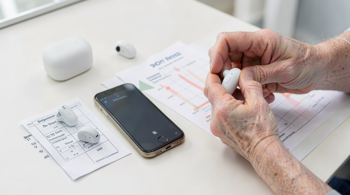
- Consider larger physical controls when dexterity is limited.
- Check whether the charging case is easy to open and position correctly.
- Confirm that the required smartphone operating system is supported.
- Assess comfort with inserting, removing, cleaning, and storing the device.
When OTC hearing aids may not be suitable
OTC devices are not a general substitute for medical assessment. The supplied research specifically identifies sudden, one-sided, painful, or rapidly progressing hearing loss as a reason to consult a licensed audiologist or ear, nose, and throat specialist first. Severe or profound loss also falls outside the intended mild-to-moderate OTC category. A professional evaluation can identify whether hearing difficulty is associated with a medical problem and can establish the degree and pattern of loss before amplification is selected. 2 3
- Seek clinical guidance for sudden or rapidly worsening symptoms.
- Do not rely on OTC amplification for severe or profound loss.
- Use professional assessment when one ear is substantially worse than the other.
- Review return and trial terms because adjustment may take time.
Costs, insurance, and continuing care
Research places premium prescription hearing aids generally within a range of $2,000 to $6,000 per pair, while OTC products occupy a broad range from approximately $500 to $2,000. Individual prices vary by technology level, fitting services, provider, accessories, and geographic market. Original Medicare Parts A and B do not cover routine hearing aids or routine fitting examinations. Part B may cover a diagnostic hearing or balance examination when ordered to investigate a medical problem, while Medicare Advantage plans vary and may include hearing benefits. 6 9
| Coverage question | Research-based answer |
|---|---|
| Original Medicare hearing aids | Routine hearing aids are not covered under Parts A and B. |
| Diagnostic examination | Part B may cover an ordered hearing or balance examination for medical diagnosis. |
| Medicare Advantage | Benefits differ by plan and require review of plan documents. |
| Ongoing care | Cleaning, charging, adjustments, repairs, and replacement planning remain necessary. |
How to interpret “best” in 2026
There is no evidence-based single winner for every senior because performance depends on hearing thresholds, speech understanding, listening environments, physical handling ability, cosmetic preferences, and access to adjustment support. A person mainly struggling in a quiet home may have different requirements from someone who loses conversations in restaurants or group settings. Tele-audiology can provide remote adjustments in some care models, while in-person services remain important when hearing loss is medically complicated or the device needs physical inspection. 4 7
- Start with the severity and pattern of hearing loss.
- Compare speech performance in noise, not only amplification volume.
- Verify battery, charging, connectivity, and support requirements.
- Distinguish clinical fitting from self-fitting and pre-tuned OTC operation.
- Check coverage rules directly with the relevant insurance plan.
Sources
- Forbes Health, “Best Hearing Aids For Seniors, According To Experts (2026)”
- U.S. Food and Drug Administration, “OTC Hearing Aids: What You Should Know”
- National Hearing Institute, “Best OTC Hearing Aids for Seniors in 2026”
- Utah Hearing Aids, “Which Hearing Aid Is Actually Best in 2026?”
- Sound Hearing, “Ultimate Guide: The Best Hearing Aids for Seniors”
- WhyNotRelax, “Best Hearing Aids for Seniors in 2026: What Medicare Covers and What to Buy”
- BestGuide, “Best Hearing Aids: Reviewed & Ranked”
- Ear Solutions Corp, “Best Hearing Aids for Seniors in 2026”
- Consumer Reports, “Best Hearing Aids”
- Healthy Hearing and Bluetooth SIG resources on rechargeable hearing aids and Auracast
Authored by MistyMountainView team