Home care approaches for mild lower back pain: Evidence-based guidance and safety considerations
When home care is generally appropriate
Mild lower back pain commonly follows a strain, awkward movement, prolonged sitting, or physical activity. Most nonspecific acute cases do not require imaging when there has been no significant trauma or warning sign. Evidence-based guidance favors maintaining activity rather than prolonged bed rest, because continued movement can improve pain intensity and function more effectively than rest alone. 1 Home care is most appropriate when symptoms remain localized, manageable, and gradually improving.
- Continue ordinary activities at a reduced intensity when possible.
- Avoid heavy lifting, forceful twisting, and movements that clearly worsen symptoms.
- Use pain and function as practical guides rather than remaining completely inactive.
Movement, walking, and gentle exercise
Low-impact movement is a central component of early management. Walking and gentle stretching can limit stiffness while allowing irritated tissues to settle. Exercise therapy is also associated with reduced pain in subacute and chronic lower back pain compared with usual care or no treatment. 1 A home routine should begin with comfortable movements and progress gradually, rather than treating pain as a reason for complete shutdown.
- Try short, easy walks and change position regularly.
- Gentle knee-to-chest and lower back rotational stretches may improve mobility.
- Stop an exercise if it produces increasing leg pain, numbness, weakness, or a sustained flare.
Heat and cold therapy
Heat therapy is identified as a first-line nonpharmacologic option for nonspecific acute lower back pain and may help relax tight muscles. 3 Warm baths or a heat pack can be used for comfort during periods of stiffness. Cold packs may be useful after a recent aggravating event when swelling or acute irritation is suspected, although the choice between heat and cold depends on the person’s symptoms and response.
- Place a cloth between the skin and a heat or cold pack.
- Use short applications and check the skin regularly.
- Do not sleep with a heating device in place or apply extreme temperatures to numb skin.
Exercises for flexibility and core support
A structured home exercise program can combine flexibility work with gradual strengthening of the muscles supporting the trunk and hips. Mayo Clinic guidance describes knee-to-chest stretches, lower back rotational stretches, and abdominal bracing exercises, with repetitions increased as movements become easier. 2 People beginning after an injury or managing ongoing pain may need individualized advice from a physical therapist or health professional before progressing.
- Perform stretches slowly and avoid bouncing.
- Begin with only a few repetitions and increase tolerance gradually.
- Prioritize controlled abdominal and trunk activation over strenuous exercises during a flare.
Posture, sitting, and sleep comfort
Long periods of sitting can contribute to back discomfort, particularly when the workstation or chair does not support a neutral posture. Short breaks to stand and stretch, along with an adjustable workstation, may reduce daily strain. 8 Sleep comfort can also improve when the spine is supported, such as by placing a pillow between the knees while side sleeping. These measures manage exposure to aggravating positions but do not replace activity.
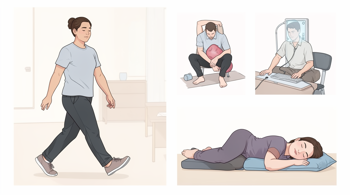
- Change position regularly instead of remaining seated for prolonged periods.
- Adjust chair height and monitor position to reduce slouching.
- Use pillows to support comfortable spinal alignment during sleep.
Medication considerations and safety limits
Over-the-counter nonsteroidal anti-inflammatory drugs, including ibuprofen, are commonly used for short-term pain relief, but they are not suitable for everyone and should be taken according to label directions or professional advice. General clinical guidance lists pain relievers and heat among common home-management strategies. 6 Medication risks, interactions, pregnancy, kidney disease, stomach ulcers, and other health conditions can affect eligibility, so persistent or uncertain use warrants medical guidance.
- Check the label for dose limits and duplicate ingredients.
- Ask a pharmacist or clinician about interactions with existing medicines.
- Do not use medication to push through worsening neurological symptoms or serious warning signs.
Warning signs and when evaluation is needed
Home care should not delay assessment when symptoms suggest a specific spinal, systemic, or referred cause. Warning signs include pain after a fall or other significant injury, fever, unexplained weight loss, a history of cancer or HIV, pain spreading down the legs, numbness, tingling, weakness, or difficulty controlling the bladder or bowels. 4 Medical review is also appropriate when pain lasts longer than two to four weeks or fails to improve.
- Seek urgent care for new bladder or bowel control problems or marked weakness.
- Arrange clinical assessment for persistent radiating pain or progressive numbness.
- Do not assume that severe or recurrent pain is a simple muscle strain.
Longer-term maintenance and realistic expectations
Most nonspecific lower back pain improves over days to several weeks, although recovery varies by cause, conditioning, age, and contributing health factors. 4 Recurrence can be managed through regular movement, progressive strengthening, ergonomic adjustments, and attention to factors such as physical deconditioning, obesity, occupational stress, and tobacco use, which are recognized contributors to back-pain risk. 5 Home care is therefore an ongoing management approach rather than a guaranteed cure.
- Resume normal activity in stages as pain and function permit.
- Maintain a sustainable exercise routine after symptoms settle.
- Seek individualized care when repeated flares interfere with work, sleep, or daily activities.
Sources
- American Family Physician, Nonpharmacologic and Nonsurgical Treatment of Low Back Pain in Adults
- Mayo Clinic, Back exercises in 15 minutes a day
- American Family Physician, Acute Low Back Pain: Diagnosis and Management
- UC Davis Health, Your top low back pain questions answered
- NCBI Bookshelf, Low Back Pain: Evaluation and Management
- Cleveland Clinic, Lower Back Pain
- Johns Hopkins Medicine, Ways to Manage Lower Back Pain
- GoodRx, Ways to Fix Lower Back Pain From Sitting
Authored by MistyMountainView team