Common causes of aching hips: An analysis of clinical triggers and diagnostic patterns
Hip pain is a significant health concern that frequently brings individuals to clinical attention, manifesting as discomfort when standing, a persistent dull ache after physical activity, or nocturnal distress that interferes with sleep 1. Understanding the origin of this pain requires an examination of the hip's anatomy, which serves as a critical junction for weight-bearing and mobility 3. Medical professionals emphasize that the specific location of the discomfort-whether in the groin, lateral hip, or buttock-serves as a primary diagnostic clue for determining the underlying pathology 1.
Anatomy of Frontal and Groin Hip Discomfort
Pain localized to the front of the hip or the groin often points toward issues residing within the hip joint itself 1. A frequent cause is hip flexor strain, where the muscles responsible for lifting the knee become irritated due to repetitive movement or acute overuse during exercise 1. Labral tears, which involve damage to the cartilage ring that stabilizes the joint, can also manifest here, often characterized by mechanical symptoms such as clicking or a sensation of the hip catching during movement 1, 11.
Arthritic conditions are another major contributor to anterior pain. Osteoarthritis, resulting from the long-term degradation of articular cartilage, often develops gradually and causes deep stiffness 1, 4. Additionally, inflammatory conditions like rheumatoid arthritis or psoriatic arthritis can induce significant pain and swelling in the same region 4. Femoroacetabular impingement (FAI) represents another significant etiology in adolescents and young adults, occurring when abnormal contact between the femoral head and the acetabular rim causes structural friction during flexion and rotation 8.
Lateral Hip Pain and Soft Tissue Syndromes
When discomfort is felt on the outside of the hip, it is frequently associated with the support tissues surrounding the joint rather than the internal articulation 1. Greater trochanteric pain syndrome (GTPS) is a widely recognized condition that replaces the older, more localized diagnosis of trochanteric bursitis 6. This syndrome involves tendinopathy or micro-tears within the gluteus medius and minimus tendons, primarily affecting individuals in their 40s to 60s, with a noted female predominance of 2-3 to 1 6, 7.
Epidemiological data indicates that GTPS has an annual incidence as high as 1.8 per 1,000 adults in primary care settings 6. Treatment for these soft tissue issues often begins with conservative measures, including physical therapy, though persistent cases may be managed with interventional techniques such as extracorporeal shock wave therapy (ESWT) or platelet-rich plasma (PRP) injections to address chronic tendon degeneration 7.
Exercise-Related Aches and Fitness-Induced Pain
The term fitness hip is often used to describe exercise-related discomfort that is not a single disease but rather a collection of symptoms stemming from overuse or improper training loads 9. This discomfort typically arises during or after activities such as running, squats, or cycling 9. Because the hip acts as a primary force-transferring mechanism between the lower limbs and the trunk, biomechanical imbalances in the pelvis or lower back can significantly contribute to these localized aches 2, 9.
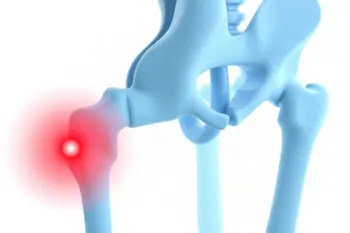
Early management strategies for exercise-induced hip pain prioritize activity modification and a gradual return to training volume 9. Clinicians caution that while temporary soreness is a common result of a new workout regimen, persistent symptoms, limping, or localized locking should prompt a professional evaluation to rule out structural injuries such as labral tears or underlying bony impingement 2, 9.
Systemic and Referred Pain Sources
Not all hip pain originates within the joint structures. A significant percentage of cases involves referred pain, where issues in the lower back-such as herniated discs or nerve irritation-manifest as discomfort in the hip and thigh region 2, 10. Sciatica is a prime example, where compression of the sciatic nerve can cause radiating pain that extends from the lower spine down through the hip and leg 10. Distinguishing between local hip joint pathology and referred spinal pain is a critical step in the diagnostic process 2.
| Category | Primary Location | Key Characteristics |
|---|---|---|
| Joint Pathology | Groin/Anterior | Stiffness, clicking, catching |
| Soft Tissue | Lateral/Outside | Tenderness over trochanter |
| Referred | Buttock/Leg | Radiating pain, lower back association |
| Overuse | Variable | Activity-related, improves with rest |
Clinical Warning Signs and Diagnostic Assessment
While many hip aches are manageable through conservative measures, clinical guidelines identify specific red flags that require urgent medical attention. These include one-sided swelling, fever, numbness, weakness, or a limb that appears pale and cold, as these can indicate serious vascular or neurological compromise 2. A thorough clinical assessment usually involves a physical examination combined with imaging modalities like ultrasound or MRI to visualize the extent of tissue damage or inflammatory changes 2, 7.
Management and Long-term Considerations
For many individuals, chronic hip conditions like osteoarthritis eventually reach a point of intractability where conservative therapies provide only limited relief 3. In these instances, treatment may escalate to surgical intervention, such as joint replacement, particularly when daily activities like walking or sitting become significantly compromised 3. However, for the majority of early-stage conditions, maintaining healthy daily habits, utilizing supportive footwear, and adhering to guided physical therapy remains the cornerstone of long-term hip health and pain prevention 2.
Sources
- Sutter Health, What Causes Hip Pain? (2026)
- Acibadem Hospitals Group, Legs Hips Ache Explained (2026)
- Harvard Health Publishing, Knees and Hips: A troubleshooting guide (2026)
- Arthritis Foundation, When Hip Pain May Mean Arthritis
- Radiopaedia, Anterior hip pain (differential) (2026)
- Radiopaedia, Greater trochanteric pain syndrome (2026)
- Springer Nature, A narrative review on greater trochanteric pain syndrome (2026)
- Springer Nature, Femoroacetabular Impingement: Current Concepts (2026)
- Acibadem Hospitals Group, Fitness Hip: Causes, Symptoms, And Treatment (2026)
- Medical News Today, Sciatica and Hip Pain Connections
- Doctor Abhinandan Punit, What Causes Hip Pain? (2026)
Authored by MistyMountainView team