Gardening Workshops for Seniors: A Report on Formats, Accessibility, and Well-Being
Gardening workshops for seniors can combine planting, practical instruction, light movement, and community connection. Documented examples include a weekly outdoor group at Abbotsford Seniors Centre in Ottawa, a senior gardening club in Evergreen, Colorado, container-gardening education in Pickering, and plant-care workshops in Milwaukee and Chicago. Dates, registration status, fees, and eligibility vary by organizer, so published event information should be checked directly rather than treated as a current availability directory.
What senior gardening workshops typically include
Workshop formats vary considerably. The Growing Together program in Ottawa uses accessible raised garden beds and meets outdoors for two hours, while Evergreen’s Green Thumb Gardening Club is structured as an eight-week senior program involving flowers, vegetables, bushes, and herbs. The Evergreen listing states that supplies are provided through the program’s registration fees, and that participants register once for the full series. 1 2
Single-session classes may focus on a narrower project. A Southern Lakes Parks and Recreation workshop teaches succulent selection, containers, soil, watering, sunlight, fertilizer, and pest control, with each participant creating an eight-inch garden using four or five plants. A Milwaukee Domes session combines a guided look at the conservatories with repotting instruction and a plant to take home. 3 5
Examples of documented programs and locations
Published event records show that senior gardening education is offered in several kinds of community settings. The Ottawa group is based at Abbotsford Seniors Centre, 950 Bank Street, and provides registration contact details for the ongoing series. An Evanston workshop, held in a senior-centre courtyard, links gardening with movement and mental wellness. The listed session includes planting an herb to take home and identifies separate member and nonmember fees. 1 7
Library branches, urban farms, recreation centres, botanical institutions, and community centres also appear in the supplied records. Chicago’s “Your Best Garden Ever” session is designed for older adults and beginners and covers containers, plant selection, common mistakes, and local growing conditions. A Pickering seminar for adults aged 55 and older addresses soil, watering, plant choices, and small-space gardening such as balconies and patios. 4 6
Accessibility and physical participation
Accessible design is central to a senior-focused gardening format. Raised beds, containers, vertical planters, tabletop projects, and houseplants can reduce bending, kneeling, and reaching. Oregon State University Extension identifies adaptations for aging that reduce strenuous movements, while Minnesota Extension describes approaches intended to make garden tasks easier for older adults. These principles can support seated and standing participation without assuming that all seniors have the same strength, balance, vision, or dexterity. 12 13
Workshop planners should provide stable paths, comfortable-grip tools, seating, shade, drinking water, and regular pauses. Activities can be arranged around short demonstrations followed by manageable tasks, rather than prolonged digging or lifting. The CDC recommends that adults aged 65 and older include aerobic, muscle-strengthening, and balance activities, while the National Institute on Aging discusses strength, endurance, flexibility, and balance as components of older-adult physical activity. Gardening instruction should complement, not replace, individualized medical advice. 8 9
Health, social, and cognitive dimensions
Gardening provides several possible dimensions of participation beyond plant production. A peer-reviewed meta-analysis reported associations between gardening and outcomes across multiple health and well-being domains, although an association does not establish that every workshop produces a specific medical result. Gardening activities may involve planning, sensory attention, fine motor work, movement, and conversation, making the format adaptable to educational, recreational, or supportive settings. 10
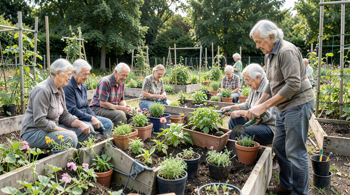
Social connection is another recurring feature. Community gardens are described by the American Community Gardening Association as shared spaces supporting participation, education, and neighbourhood connection. Ottawa’s raised-bed group explicitly combines planting and community contact, while the Milwaukee program allows adults aged 60 and older to attend with a caregiver or guest. These arrangements may reduce isolation for some participants, but attendance preferences, transportation, language, and comfort with group activity remain individual considerations. 1 5 14
Choosing a suitable workshop format
Beginners may look for sessions with a defined project, clear instructions, and limited equipment requirements. Container vegetables, herbs, houseplants, propagation, seed starting, composting, and seasonal maintenance are common curriculum categories identified in gardening education resources. Chicago’s documented library workshop illustrates a beginner-oriented approach by addressing plants suited to local conditions, container use, and avoidable mistakes. Botanical gardens and university Extension services can provide locally relevant teaching materials and demonstrations. 4 15 17
The right format also depends on physical capacity and desired commitment. A one-time succulent project may suit someone seeking a contained seated activity, whereas an eight-week garden club requires recurring attendance and participation across changing seasons. Adult education programs at Chicago Botanic Garden and Missouri Botanical Garden demonstrate how botanical institutions can support structured horticulture learning for lifelong learners. Questions about session length, indoor or outdoor conditions, tools, transportation, accessibility, and whether materials are included should be answered before registration. 2 3 15 16
Risks, maintenance, and verification
Gardening remains a physical activity with practical risks. Heat sensitivity, allergies, medication schedules, limited vision or hearing, balance concerns, soil exposure, fertilizers, sharp tools, and lifting requirements may affect suitability. A responsible program should explain supervision, sanitation, tool handling, rest arrangements, and emergency procedures. Horticultural therapy should not be confused with a general gardening class: the American Horticultural Therapy Association defines it as a professionally facilitated practice connected to treatment or rehabilitation goals. 11
Planting is only the beginning of the task. Participants may need to monitor watering, light, humidity, soil, pests, fertilizer, pruning, and seasonal changes after a workshop. The Milwaukee session, for example, includes instruction on watering, humidity, soil, repotting, and light needs, while the succulent class addresses comparable care requirements. Event pages can also show ended sales or dates that require confirmation, so location, age threshold, cost, registration, cancellation terms, and current scheduling should be verified with the named organizer. 3 5
Sources
- The Glebe BIA, Growing Together: Nature Based Gardening for Urban Seniors, https://intheglebe.ca/event/growing-together-nature-based-gardening-for-urban-seniors/2026-09-15/
- Active, Green Thumb Gardening Club-Fall, https://www.active.com/evergreen-co/gardening/classes/green-thumb-gardening-club-fall-2026
- Southern Lakes Parks & Recreation, Senior Succulent Garden Workshop, https://slpr.net/programs/senior/senior-succulent-garden-workshop/
- Windy City Seniors, Grow Your Best Garden Ever, https://www.windycityseniors.com/event-details/grow-your-best-garden-ever
- Milwaukee Domes Alliance, Growing and Thriving Workshop, https://milwaukeedomes.org/learn/growing-and-thriving/
- All About Durham, Container Gardening Workshop Pickering, https://allaboutdurham.com/container-gardening-workshop-pickering/
- Evanston RoundTable, Gardening and Wellness Workshop, https://evanstonroundtable.com/2026/08/04/levy-senior-center-to-host-gardening-and-wellness-workshop-aug-14/
- Centers for Disease Control and Prevention, Physical Activity for Older Adults, https://www.cdc.gov/physical-activity/php/older-adults/index.html
- National Institute on Aging, Exercise and Physical Activity, https://www.nia.nih.gov/health/exercise-and-physical-activity
- Preventive Medicine Reports, Gardening and Health Meta-analysis, https://doi.org/10.1016/j.pmedr.2016.11.007
- American Horticultural Therapy Association, Horticultural Therapy, https://www.ahta.org/horticultural-therapy
- Oregon State University Extension Service, Gardening and Aging, https://extension.oregonstate.edu/gardening/techniques/gardening-aging
- University of Minnesota Extension, Gardening and Aging, https://extension.umn.edu/yard-and-garden-news/gardening-and-aging
- American Community Gardening Association, Resources, https://www.communitygarden.org/resources
- Chicago Botanic Garden, Adult Education, https://www.chicagobotanic.org/education/adult
- Missouri Botanical Garden, Adult Education, https://www.missouribotanicalgarden.org/learn-discover/adult-education
- National Gardening Association, Learn, https://garden.org/learn/
Authored by MistyMountainView team