Understand Parkinson's disease treatment options: A clinical overview
Understand Parkinson's disease treatment options by examining the medication, therapy, lifestyle, and surgical approaches used to manage symptoms. Parkinson's disease has no current cure, but individualized treatment can improve movement, preserve function, and support quality of life as symptoms change over time. 1
How treatment plans are organized
Parkinson's treatment is tailored to symptoms, age, lifestyle, disease stage, general health, and personal treatment goals. A plan may begin with one medication or structured exercise, then change as motor symptoms, sleep problems, mood changes, swallowing difficulty, cognition, or medication side effects emerge. Regular neurological follow-up is important because treatment needs evolve with disease progression rather than remaining fixed after diagnosis. 1
Care is often multidisciplinary. A movement disorder specialist may coordinate with physical, occupational, and speech therapists, while mental health professionals can address depression, anxiety, adjustment difficulties, and other nonmotor concerns. Parkinson's disease is progressive, and management therefore focuses on maintaining independence and daily function while balancing symptom relief against adverse effects. 3
Levodopa and other core medicines
Levodopa combined with carbidopa remains the central medication approach for many motor symptoms. Levodopa is converted into dopamine in the brain, while carbidopa helps prevent peripheral breakdown before levodopa reaches the brain. The American Academy of Neurology guidance described in the supplied research identifies levodopa as providing superior motor benefit compared with dopamine agonists and MAO-B inhibitors, particularly for many people older than 60. 2
Dopamine agonists such as pramipexole and ropinirole stimulate dopamine receptors rather than supplying levodopa directly. MAO-B inhibitors, including rasagiline and selegiline, reduce enzymatic dopamine breakdown and may be used alone for mild symptoms or alongside levodopa. Medication selection depends on symptom severity, functional effect, age, cognitive status, and risks such as impulse-control problems, sleepiness, hallucinations, or confusion. 2
Managing wearing-off and dyskinesia
As Parkinson's disease progresses, a dose of levodopa may provide benefit for a shorter period. This wearing-off pattern can lead to alternating periods of improved movement and renewed stiffness, slowness, or tremor. Clinicians may adjust dose timing or formulation, or add a COMT inhibitor such as entacapone or opicapone, an MAO-B inhibitor such as safinamide, or an adenosine A2A antagonist such as istradefylline to extend levodopa's effect. 2
Dyskinesia refers to involuntary movement that may occur after prolonged levodopa exposure or during periods of high medication effect. Amantadine extended-release is identified in the supplied research as an FDA-approved option for levodopa-induced dyskinesia, although dose changes may also be considered. Anticholinergic drugs can sometimes help tremor in younger patients, but their cognitive and other side effects make them less commonly used in older adults. 2
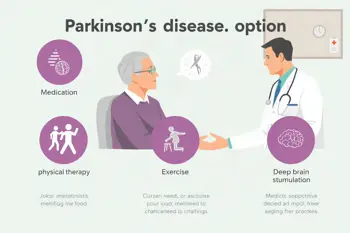
Rehabilitation, exercise, and daily function
Rehabilitation is a core part of treatment rather than an optional supplement to medication. Physical therapy can target gait, balance, strength, flexibility, freezing, and fall risk. Occupational therapy focuses on daily activities, home routines, and practical adaptations, while speech therapy can address reduced voice volume, communication, and swallowing problems. These interventions are selected according to the person's specific functional limitations. 3
Regular exercise and movement are associated with improved motor function and may help form new brain connections that reduce symptoms or potentially slow progression. Treatment plans may also include attention to sleep, nutrition, stress management, social participation, and safety at home. These measures do not reverse Parkinson's disease, but they can support mobility, participation, and quality of life alongside medical treatment. 1
Advanced medication delivery and surgery
Advanced options may be considered when motor fluctuations or dyskinesias substantially affect quality of life despite optimized medication. Options described in the supplied research include extended-release levodopa, apomorphine rescue injections, intestinal carbidopa-levodopa gel delivered through a feeding tube, and continuous subcutaneous levodopa infusion. These approaches require specialist assessment, device management, and ongoing monitoring rather than representing a permanent cure. 2
Deep brain stimulation uses implanted electrodes and a neurostimulator to influence movement-related brain circuits. It may help selected people whose motor symptoms remain difficult to control or whose medication response is unstable. Surgical or lesion-based procedures are not appropriate for everyone, particularly when significant dementia or other medical risks are present. Eligibility depends on symptom pattern, medication responsiveness, cognition, general health, and the expected balance of benefit and risk. 4
Risks, monitoring, and long-term decisions
Parkinson's medicines can produce clinically important adverse effects, and the same drug may be useful for one person but unsuitable for another. Dopamine agonists may be associated with sleepiness, hallucinations, or impulse-control problems, while anticholinergic medicines can worsen cognition in vulnerable patients. Levodopa-related fluctuations and dyskinesia may require adjustments over time. Medication should therefore be changed under clinical supervision rather than stopped abruptly or altered independently. 2
Long-term care requires monitoring of both motor and nonmotor symptoms. Parkinson's disease can involve depression, anxiety, constipation, sleep disturbance, autonomic dysfunction, cognitive decline, pain, speech changes, and swallowing problems, and these issues may contribute substantially to disability. A movement disorder specialist can reassess diagnosis, treatment response, side effects, rehabilitation needs, and whether advanced therapy is suitable as the condition changes. 5
Sources
- Parkinsons.org, Parkinson's Disease Treatments
- Parkinsons.org, Parkinson's Disease Medications
- Penn Medicine, Parkinson's Disease Treatment
- Merck Manual Professional Edition, Parkinson Disease
- Cold Spring Harbor Perspectives in Medicine, Clinical Management of Parkinson's Disease
Authored by MistyMountainView team