Cremation pricing in the United States 2026: A data-based consumer analysis
How much does cremation cost in 2026? Prices by state vary widely, and the answer depends on whether the arrangement is direct cremation, a memorial service, or a full-service event. Available 2026 analyses place typical direct cremation costs near $1,995 to $2,202 nationally, while more elaborate arrangements can exceed $6,000. 1
National cremation price benchmarks
Direct cremation is generally the simplest arrangement because it does not include embalming, a viewing, or a formal ceremony before cremation. A 2026 analysis of more than 1,000 funeral-home price lists reported a median direct cremation charge of $1,995, with observed prices ranging from $575 to $6,285. Another national estimate placed the average at approximately $2,202, illustrating why a single national figure should be treated as a benchmark rather than a guaranteed quote. 2
Other service levels create a much higher total. Published 2026 ranges place cremation followed by a memorial service at roughly $2,000 to $4,000, while full-service cremation with viewing commonly falls between $4,500 and $8,000. A separate state comparison estimated full-service averages from about $4,800 to more than $7,500. These figures may describe funeral-home charges only and may not include every merchandise or disposition expense. 3
What the main service categories include
Direct cremation typically involves transfer into the provider's care, required paperwork and permits, the cremation itself, and return of the cremated remains in a temporary container. It normally excludes visitation, embalming, and a formal ceremony arranged by the funeral home. Families may organize a memorial later, which separates the timing of remembrance from the immediate disposition. 4
A memorial cremation adds an organized gathering, staff support, facility use, and related coordination. Full-service cremation generally adds viewing or visitation, preparation of the body, ceremony arrangements, and sometimes upgraded merchandise. Because providers define packages differently, a quoted total should be checked against an itemized list rather than compared solely by the package name. 5
| Arrangement | Indicative 2026 range | Typical distinction |
|---|---|---|
| Direct cremation | $800 to $3,500 | No formal service or viewing |
| Memorial cremation | $2,000 to $4,000 | Cremation with a memorial gathering |
| Full-service cremation | $4,500 to $8,000 | Viewing, ceremony, and cremation |
Why prices differ by state and locality
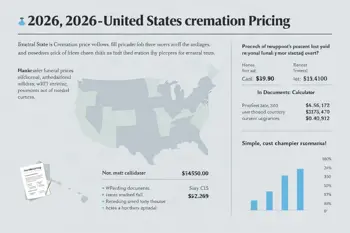
Location is a major pricing variable. A 2026 state comparison reported direct cremation averages of approximately $1,282 in Oregon and $3,183 in North Dakota. The same dataset listed Connecticut near $3,150, Arizona near $1,433, California near $2,400, and Alaska near $2,800. Such differences reflect local operating costs, provider competition, regulatory requirements, and regional demand. 6
Prices can also vary within one state or metropolitan area. Urban facilities may carry higher property, staffing, transportation, and administrative costs, while independent crematories and online-oriented providers may use different operating structures. Geographic comparisons therefore have limits: two quotes may cover different transfer distances, containers, permits, death certificates, or timing requirements even when both are labeled direct cremation. 7
| State example | Reported direct cremation figure |
|---|---|
| Oregon | Approximately $1,282 |
| Arizona | Approximately $1,433 |
| California | Approximately $2,400 |
| Connecticut | Approximately $3,150 |
| North Dakota | Approximately $3,183 |
Additional charges that affect the total
The advertised base price may not represent the final amount. Common additions include transportation beyond a standard service area, extra certified death certificates, urns or upgraded containers, witness services, memorial facilities, obituary placement, and permits associated with scattering or other final disposition choices. Published consumer guidance indicates that add-ons and location-specific charges can materially increase the baseline amount. 8
Timing and service complexity can also affect the invoice. Weekend coordination, rush handling, extended holding, special transfer circumstances, and family-requested ceremonies may be priced separately. A practical comparison should therefore record what is included, what is optional, whether taxes or regulatory fees apply, and whether the quoted amount covers return of the remains. 9
- Transfer and mileage charges
- Certified death certificates
- Urns, keepsakes, and containers
- Witness or identification services
- Memorial venue and staff fees
- Scattering permits or other disposition expenses
Consumer protections and comparison methods
The Federal Trade Commission Funeral Rule requires funeral providers to disclose price information and provide a General Price List, helping consumers examine services separately instead of accepting an unexplained package total. The rule also supports telephone price inquiries and itemized comparisons. These protections do not establish a uniform national price, and state requirements may add further paperwork or operational conditions. 10
Price comparisons are most reliable when each provider receives the same written request. The request should specify direct or full-service cremation, the location of the deceased, the desired container, transportation needs, memorial plans, and the expected number of death certificates. The resulting documents should be reviewed for mandatory fees, optional merchandise, third-party charges, cancellation terms, and responsibility for transporting the remains. 11
Market direction and planning considerations
Cremation has become the most common form of final disposition in the United States. One 2026 report placed the 2025 cremation rate at 63.4% and cited an NFDA projection of 82.3% by 2045. Rising adoption may expand provider capacity, but it does not guarantee consistent pricing because local markets, facility ownership, transportation networks, and state regulation continue to shape individual quotes. 12
Planning considerations extend beyond the cremation fee. A decision-maker should identify the intended service type, determine who will authorize arrangements, document preferences for the remains, and account for recurring or later expenses such as a memorial gathering or permanent urn placement. Prearrangement can clarify preferences, but any agreement should be examined for funding structure, portability, cancellation rules, inflation treatment, and the responsibilities of the provider or trustee.
- Define whether the arrangement is direct, memorial, or full-service.
- Request an itemized General Price List and written total.
- Separate required charges from optional merchandise and ceremonies.
- Confirm transportation, timing, permits, and return of the remains.
- Review funding, portability, cancellation, and administrative terms before signing.
Sources
- Memorial Merits, “How Much Does Cremation Cost in 2026? Prices by State”
- Asurgo, “Average Funeral Cost by State 2026”
- Price of Cremation, “Cremation Prices in 2026”
- Local Cremation Guide, “2026 Cremation Cost Index”
- SeniorBurialQuote.com, “Cremation Cost by State 2026”
- After, “2026 Direct Cremation Cost Guide”
- Funeral Home Directories, “Direct Cremation: Complete Guide and Cost by State”
- After, “Cremation Package Prices in 2026”
- US Funerals Online, “Average Cost of Cremation 2026”
- Federal Trade Commission, “Shopping for Funeral Services”
- Funeral.com, “2026 Cremation Costs and Memorial Options Guide”
- National Funeral Directors Association, statistics on cremation trends
Authored by MistyMountainView team