Train tours through Italy: Routes, Rail Operators, and Practical Planning
Train tours through Italy can be organized around major art cities, regional rail connections, or longer journeys from Venice to Sicily. The available itineraries show several distinct formats, including independent high-speed rail travel, escorted group programs, and luxury train voyages that combine overnight accommodation with scheduled sightseeing.
Italy’s main rail network and operators
Trenitalia operates Frecciarossa, Frecciargento, and Frecciabianca high-speed services, together with Intercity and regional trains. Italo is a private high-speed operator serving major cities such as Turin, Milan, Bologna, Florence, Rome, Naples, and Salerno. These two operators form the principal long-distance options for travelers moving between Italy’s largest urban destinations. 1
Regional services remain important because many smaller destinations and excursion areas are not connected directly by high-speed trains. Trenord covers Lombardy, including routes involving Milan, Lake Como, Bergamo, and Brescia, while regional rail can also support visits to the Cinque Terre, Tuscany, and other areas outside the main intercity corridor. 2
Common north-to-south itineraries
A frequently used cultural sequence is Milan, Venice, Florence, Rome, and Naples, although organized tours vary the order and length of each stop. Rail-based programs commonly emphasize the contrast between Venice’s canals, Milan’s fashion and commercial identity, Florence’s Renaissance collections, Rome’s ancient monuments, and Naples’ southern setting. 3
One researched eight-day itinerary begins in Venice, continues to Milan and Florence, and ends in Rome. Its stated structure includes time for St. Mark’s Square, Milanese city exploration, Renaissance art and architecture, and Roman landmarks including the Colosseum. The format combines hotel logistics with timed train journeys, leaving travelers to explore independently between scheduled movements. 4
Longer journeys from Venice to Sicily
A 10-day north-to-south program travels from Venice through Tuscany and Rome toward southern Italy and Sicily. Its listed highlights include high-speed Frecciarossa services, Pisa and Lucca, Pompeii and Mount Vesuvius, and a journey around Mount Etna on the historic Circumetnea narrow-gauge railway. The program is designed for groups of 16 to 25 people and includes separate luggage transport on line routes. 5
Another researched route links Venice, Florence, Rome, and Naples over eight nights, covering 730 kilometers with a stated rail travel time of 4 hours and 47 minutes between the principal cities. The itinerary uses Frecciarossa trains and presents backpacker, premium, and luxury categories with different accommodation and transport inclusions. Published figures range from 420 euros for the listed backpacker category to 880 euros for the listed luxury category. 6
Luxury and heritage train formats
Luxury train tours follow a different model from ordinary intercity travel. Golden Eagle’s six-day “A Taste of Italy” route runs from Taormina to Ragusa, Palermo, Maratea, Verona, and Venice aboard the Golden Eagle Danube Express. Its published 2027 date is September 7 to September 12, with per-person twin occupancy listed at 14,000 euros for Deluxe Class and 17,500 euros for Superior Deluxe Class. 7
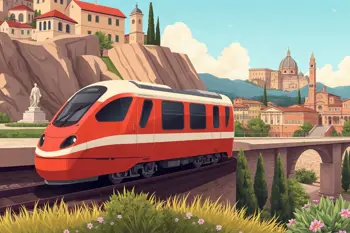
La Dolce Vita Orient Express lists a five-day, four-night round trip from Rome through Venice, Matera, Taormina, and Palermo. A separate three-day, two-night route connects Rome, Portofino, Venice, and Florence. These journeys emphasize onboard dining, cabins, curated excursions, and the experience of traveling on a dedicated luxury train rather than simply using rail as transport between hotels. 8
What organized rail tours may include
Organized programs differ substantially in their inclusions, so the itinerary description should be read as a package specification rather than a simple train timetable. A 13-day rail itinerary covering Venice, Florence, Cinque Terre, Rome, and Sorrento lists accommodations, rail travel, city tours, gallery visits, a Cinque Terre pass, wine tasting, a sunset cruise, Pompeii and Vesuvius sightseeing, and private transfers. 9
| Tour format | Typical structure in the research | Primary focus |
|---|---|---|
| Independent rail itinerary | High-speed trains between hotels and major cities | Flexible exploration |
| Escorted group tour | Guides, scheduled activities, and shared logistics | Interpretation and coordination |
| Luxury train voyage | Dedicated train, cabins, dining, and excursions | Onboard hospitality and heritage travel |
Reservations, passes, and operational risks
Travelers using Eurail or Interrail passes can access many Italian services, but high-speed trains and some international routes generally require seat reservations. Advance-purchase and flexible fare categories exist on high-speed services, while regional tickets follow simpler rules. Pass eligibility, reservation fees, train class, and ticket conditions should therefore be checked before assuming that a pass covers every segment. 1
Rail planning also has operational friction. Official schedules can change because of engineering works, strikes, and seasonal timetable adjustments, and regional connections may require more careful coordination than direct high-speed routes. A practical itinerary should allow for station transfers, luggage handling, late arrivals, and the possibility that a scenic or historic service operates less frequently than a standard intercity train. 2
How to compare routes objectively
The most useful comparison is not simply the number of destinations. A short city itinerary may provide more unscheduled time, while a long north-to-south route offers greater geographic range but more frequent hotel changes and transfers. Luxury journeys add onboard accommodation and dining, but their published costs are far above conventional hotel-and-rail programs. The appropriate format depends on tolerance for fixed schedules, guided activities, luggage movement, and high package complexity.
Before selecting an itinerary, examine the exact cities, nights, train classes, transfers, meals, excursions, and cancellation conditions. It is also important to distinguish travel time from total trip duration, since a tour described as eight or ten days can include arrival, departure, hotel, and sightseeing days beyond the hours spent on trains. Official operator information remains the relevant reference for schedules and reservation requirements. 1
Sources
- Trenitalia, https://www.trenitalia.com/en.html
- Trenord, https://www.trenord.it/en/routes-and-timetables/
- Eurail, https://www.eurail.com/en/plan-your-trip/trip-ideas/suggested-itineraries/italy
- Rail Escape, https://www.railescape.com/tours/best-of-italy-venice-to-rome/
- Inventia, https://www.inventia.de/en/reiseziele/europa/italien-reisen/mit-linienzuegen-einmal-durch-ganz-italien-von-nord-nach-sued-2026-2027/
- EcoJourneys Spain, https://ecojourneyspain.com/en/ecojourney-english/sustainable-travel-in-italy/north-to-south-italy/
- Golden Eagle Luxury Trains, https://www.goldeneagleluxurytrains.com/a-taste-of-italy/
- La Dolce Vita Orient Express, https://www.orient-express.com/la-dolce-vita/itinerary/the-grand-tour/
- Flat Beds Tour + Cruise, https://flatbedstravel.com.au/deals/italy-cinque-terre-amalfi-coast-by-rail/
Authored by MistyMountainView team