Low-Impact Fitness Programs for Older Adults: A Practical Evidence-Based Guide
Low-impact fitness programs for older adults are designed to help people move better without placing unnecessary stress on the knees, hips, ankles, or lower back. Suitable routines commonly combine walking, chair exercises, gentle strength work, balance practice, mobility training, and water-based activity rather than relying on high-impact running or jumping.
What Low-Impact Exercise Means
Low-impact movement generally keeps at least one foot on the floor or uses a supported position, such as sitting in a sturdy chair. Walking, cycling, swimming, water aerobics, resistance-band exercises, tai chi, chair yoga, and controlled bodyweight movements fit this category because they reduce repeated jumping, sprinting, hard landings, and abrupt direction changes. Low impact does not mean ineffective. It can still challenge the heart, muscles, coordination, and range of motion when effort is adjusted appropriately. 2
The main distinction is how force is placed through the body, not whether exercise feels easy. A person may increase challenge by walking longer, adding resistance, performing slower repetitions, or reducing seated support. Adults returning after inactivity can begin with small amounts and gradually increase duration or intensity as tolerance improves. 4
Core Components of a Complete Program
Public-health guidance describes a balanced older-adult program as a combination of aerobic activity, muscle strengthening, and balance work. Flexibility and mobility exercises are also useful for maintaining comfortable joint movement and supporting everyday tasks. A routine focused only on cardio may not address leg strength or stability, while strength work alone may not develop sustained aerobic capacity. 1
- Aerobic activity: walking, cycling, or water exercise.
- Strength: chair squats, wall push-ups, heel raises, or resistance bands.
- Balance: supported weight shifts, step taps, or tai chi-inspired movements.
- Mobility: controlled movements for the hips, shoulders, ankles, and spine.
Moderate intensity is commonly described as breathing and heart rate becoming noticeably higher while conversation remains possible. The appropriate level still depends on health status, mobility, medication effects, and prior conditioning. 3
Weekly Activity Targets and Scheduling
U.S. physical-activity guidance recommends that older adults work toward 150 to 300 minutes of moderate-intensity aerobic activity each week, or 75 to 150 minutes of vigorous activity, together with muscle-strengthening activity on at least two days. These figures are targets rather than an immediate requirement for someone who is inactive, deconditioned, or managing a health limitation. 3
A practical schedule can divide movement into shorter sessions across the week. For example, walking or water exercise can occupy several days, while strength and balance practice can be included on two or more separate days. A beginner plan described in the supplied research starts with three structured workout days and progresses to four, using short sessions and recovery periods to support consistency. 4
Examples of Joint-Friendly Exercises
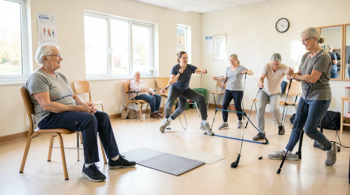
Chair-based movements can provide a supported starting point for people who experience weakness, stiffness, or uncertainty while standing. Seated marching raises alternating knees, standing side steps train lateral movement, and chair squats develop the leg and hip muscles used when rising from a seat. Wall push-ups, heel raises, and step taps add upper-body, calf, and coordination work without requiring floor transfers. 1
Resistance bands are another adaptable option. They are portable and can be used for exercises involving the shoulders, upper back, hips, and legs. Physical-therapy guidance identifies bands as tools used in rehabilitation contexts, including knee osteoarthritis management, hip strengthening after surgery, and rotator-cuff recovery, although the correct movement and resistance must match the individual’s condition. 5
Balance, Falls, and Functional Independence
Balance training addresses the ability to control the body’s center of gravity during standing, stepping, and changes in direction. Supported standing exercises may include side-to-side weight shifts, heel-to-toe walking, step taps, or brief single-leg practice while holding a chair or countertop. Tai chi uses slow, deliberate weight transfers and controlled posture, offering a low-impact way to practice coordination and body awareness. 7
Strength and balance are closely connected to daily function. Leg and hip exercises can support tasks such as standing from a chair, climbing stairs, carrying groceries, and walking over uneven surfaces. Balance drills should be performed near stable support, with clear floor space and suitable footwear when appropriate. A person who cannot stand safely without assistance may need professional assessment before attempting unsupported balance work. 1
Safety, Medical Considerations, and Program Limits
Exercise plans should be adapted for chronic conditions, significant mobility limitations, recent surgery, joint pain, heart disease, osteoporosis, or other conditions that affect safe movement. A healthcare professional can help determine suitable activities and restrictions, particularly after a long period of inactivity. Exercise should stop when chest pain, dizziness, unusual shortness of breath, or sharp or worsening joint pain occurs. 4
Low impact reduces mechanical stress but does not eliminate all risk. Poor technique, excessive resistance, unstable furniture, inadequate recovery, and progression that occurs too quickly can still cause injury or excessive fatigue. Group classes may provide social support and coaching, but participants should verify that instructors offer seated, supported, and reduced-range alternatives. Programs should not assume that every adult over 60 has the same strength, balance, or medical needs. 6
Progression and Long-Term Adherence
Progression can occur through several variables: adding minutes, increasing repetitions, completing another circuit, using slightly greater resistance, or performing a movement with improved control. A slow-tempo approach emphasizes alignment, breathing, deliberate range of motion, and generous rest instead of speed or maximal loading. This approach is relevant for people prioritizing joint health, movement quality, and long-term participation. 8
Consistency is more important than an exhausting single session. Programs that combine aerobic conditioning, strength, balance, and mobility can be adjusted around pain, fatigue, transportation, weather, and access to equipment. Walking, chair exercise, cycling, water activity, and tai chi provide different formats, allowing an older adult to select activities that are comfortable enough to repeat while still providing a measurable challenge. 9
How to Evaluate a Fitness Program
A suitable program should clearly identify its intended fitness level, session length, equipment requirements, support options, and progression method. It should explain warm-up and cool-down practices, include balance and strength rather than only aerobic movement, and provide alternatives for seated or standing participants. Claims should be specific and proportionate, avoiding guarantees that exercise will prevent injury, cure pain, or produce identical results for every participant. 10
- Look for gradual progression and recovery guidance.
- Check whether exercises can be modified for balance or joint limitations.
- Prefer clear instructions on posture, breathing, and safe support.
- Avoid routines built around pain, exhaustion, speed, or competitive pressure.
The most appropriate program is therefore an adaptable plan that matches current ability and can be sustained over time. Medical advice may be necessary before participation, and periodic reassessment is sensible when symptoms, medications, surgery status, or mobility change.
Sources
- Centers for Disease Control and Prevention, cdc.gov/physical-activity-basics/guidelines/older-adults.html
- National Institute on Aging, nia.nih.gov/health/exercise-and-physical-activity/exercise-and-physical-activity-older-adults
- U.S. Department of Health and Human Services, health.gov/sites/default/files/2019-09/Physical_Activity_Guidelines_2nd_edition.pdf
- MedlinePlus, medlineplus.gov/exerciseforolderadults.html
- Senior Fitness Lab, seniorfitnesslab.com/resistance-band-exercises-for-seniors/
- National Council on Aging, ncoa.org/article/how-to-get-started-with-exercise
- Aspen Alcove, aspenalcoveclinton.com/best-low-impact-exercises-for-seniors-to-stay-active/
- Kettlebell Workout, kettlebellworkout.net/exercises/year-long-low-impact-kettlebell-program-for-joint-health.php
- Arthritis Foundation, arthritis.org/health-wellness/healthy-living/physical-activity/getting-started/low-impact-exercises
- American College of Sports Medicine, acsm.org/education-resources/trending-topics-resources/physical-activity-guidelines
Authored by MistyMountainView team