What Do Nurses Make in the United States? An Analytical Review of Nursing Compensation Trends
Understanding the current financial landscape of the nursing profession requires an examination of government-reported wage data, regional cost-of-living adjustments, and the distinct salary tiers associated with clinical specializations. As of the May 2025 Bureau of Labor Statistics (BLS) Occupational Employment and Wage Statistics (OEWS) release, the national median annual wage for registered nurses (RNs) reached $97,550 1, 2. This figure serves as a primary benchmark for the profession, though actual earnings are shaped by a complex interplay of experience, state mandates, and local demand for care 2, 8.
National Wage Benchmarks and Occupational Tiers
The hierarchy of nursing compensation is defined largely by educational requirements and clinical scope of practice. Entry-level roles, such as nursing assistants, currently report a median annual wage of approximately $39,530, whereas licensed practical and vocational nurses (LPN/LVN) occupy a tier with a median of $62,340 1. Moving into advanced practice, the financial ceiling increases significantly. For instance, nurse practitioners report a median annual wage of $129,210, while nurse anesthetists (CRNAs) represent the highest tier of the nursing compensation ladder with a national median reaching $223,210 1, 3.
Variability remains a hallmark of these figures. While the median RN salary is $97,550, the distribution of income is wide; the lowest-earning decile of registered nurses earns less than $68,940, while the highest-earning decile exceeds $137,470 2. These figures are based on employer-reported payroll data, providing a more stable reflection of actual mid-career earnings compared to speculative job posting boards 2, 8.
The Impact of Geography on Nursing Earnings
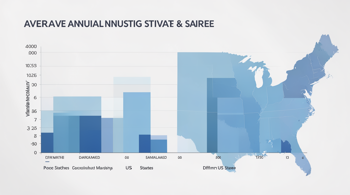
Geographic location remains the most significant predictor of variance in nursing wages. Coastal regions, particularly those with strong union representation and statutory nurse-to-patient ratios, consistently report the highest average annual salaries 4, 7. California currently leads the nation, with an average RN salary often exceeding $150,000 in specific reporting cycles, followed closely by Hawaii, Oregon, and Washington 3, 9. Conversely, states in the southeastern United States, such as Alabama and Mississippi, typically report lower annual mean wages, sometimes falling below $80,000 for standard staff RN positions 1, 4, 9.
However, when researchers adjust these raw numbers for regional cost-of-living differences, the rankings shift substantially. High-cost states, while offering larger gross paychecks, may provide less purchasing power than lower-cost regions 3, 6. For example, when factoring in local rental costs and essential services, the perceived salary advantage of certain metropolitan hubs is mitigated by the higher daily expenses required to maintain a consistent quality of life 7.
Professional Sentiment and the Inflation Gap
Despite reports of rising median wages, a significant disconnect exists between statistical growth and the perceived financial stability of the workforce. According to a 2026 salary survey, approximately 93% of surveyed nurses reported that their compensation has failed to keep pace with inflation and increased workplace demands 5. Nearly half of these respondents indicated that they feel they are falling behind financially, while a notable segment expressed concern regarding "salary compression," where newer hires are brought into the workforce at rates comparable to or higher than those of experienced staff 5.
This sentiment is further complicated by the efficacy of annual raises. Data suggests that for a majority of the nursing population, raises are frequently offset by the rising cost of living, with 84% of surveyed nurses stating that their most recent pay adjustment did not meaningfully improve their long-term financial security 5. These figures highlight that wage data, while informative for market tracking, does not always capture the subjective financial stressors experienced by practitioners on the ground 5.
The Role of Clinical Specialty and Industry Setting
Beyond geography, the specific healthcare environment and clinical specialty exert downward or upward pressure on annual earnings. Nurses working in outpatient centers, private surgical suites, or as part of specialized travel nursing agencies often see different pay structures than those employed in traditional inpatient hospital settings 4, 8. Travel nurses, in particular, may command higher temporary salaries-often ranging between $95,000 and $150,000-to compensate for the lack of permanent benefits and the necessity of geographic mobility 4.
Advanced practice roles also demonstrate clear financial premiums. A nurse practitioner, for instance, may earn a 35% salary premium over a staff registered nurse, while the gap between a standard staff nurse and a nurse anesthetist can exceed 145% 3. These differentials reflect the increased diagnostic responsibility, specialized training, and clinical autonomy inherent in advanced nursing practice, which continue to attract significant workforce interest 3, 8.
Projections and Future Market Conditions
The demand for nursing talent is expected to remain high, with projections indicating a continued need for clinical staff through 2034. Nurse practitioners, in particular, are identified as one of the fastest-growing occupations in the U.S. economy, with expected growth rates near 40% 3. This sustained demand is driven by an aging national demographic that requires higher levels of consistent medical intervention and chronic disease management 7.
Despite this projected demand, the industry faces a structural shortfall, with current estimates suggesting a gap of approximately 100,000 registered nurses 4. As healthcare systems grapple with these labor shortages, the competition for talent is likely to influence future salary trajectories. Whether these pressures will translate into meaningful real-wage growth for the majority of the workforce or remain focused on specific specialties and locations is a critical subject for ongoing economic observation 5, 8.
Understanding Compensation Data
For those researching nursing salaries, it is essential to distinguish between various data sources. The BLS Occupational Outlook Handbook and OEWS releases provide the most consistent, employer-verified datasets, though they often lag behind current market conditions by several months 2. When interpreting these statistics, analysts should account for the vintage of the data, as wage surveys published in 2026 may reflect 2025 employment trends 2, 4.
Ultimately, a career in nursing involves multifaceted financial considerations. The decision to pursue specific educational tracks or geographic relocations involves an evaluation of long-term return on investment, personal cost-of-living requirements, and the distinct pay structures of different nursing disciplines 1, 6, 8. By synthesizing these factors, one can form a clearer understanding of the economic realities facing the contemporary nursing workforce 8.
Sources
- Nursing License Map: Nurse Salary by State (2026 Edition)
- ScrubScope: Registered Nurse Salary in 2026
- The Nursing Directory: Nursing Salary & Career Data 2026
- NurseSalaryIntel: Nurse Salary Data 2026
- NurseOneStop: Nurse.org Salary Survey 2026 Results
- SmartAsset: Where It Pays to Be in Nursing (2026 Study)
- Nurse Salary Data: Nurse Salary by State 2026
- SkillGigs: How Much Do Registered Nurses Make in 2026?
- Mappr: Registered Nurse Salary by State (2025)
Authored by MistyMountainView team