Train tours across Switzerland: An Analytical Overview of Panoramic Rail Routes
Train tours across Switzerland represent a sophisticated integration of national rail infrastructure designed to traverse diverse alpine topography, connecting urban centers with remote mountain landscapes 1. The network is anchored by the Grand Train Tour of Switzerland, a comprehensive 1,280-kilometer circuit that harmonizes six distinct panoramic rail lines into a singular, flexible travel framework 11. This system serves as both a transportation utility and a recognized model for sustainable, high-capacity tourism, facilitating access to eleven distinct lakes and five UNESCO World Heritage sites 11.
The Grand Train Tour of Switzerland Infrastructure
The Grand Train Tour of Switzerland is not a single, scheduled service but a modular, route-based construct that allows travelers to customize their journeys based on regional interests 11. By leveraging the country’s existing, highly synchronized rail, bus, and boat networks, this framework provides a high degree of adaptability for planning multi-day expeditions 1. Industry data suggests that the tour can be segmented into varying timeframes, typically ranging from seven to ten days, depending on the number of excursions or regional stops selected by the traveler 11.
Operational success within this network often relies on the utilization of the Swiss Travel Pass, which provides unlimited access to much of the public transit system, including mountain excursions and discounted travel on specific lines 1. Furthermore, luggage transfer services between major stations allow for seamless transitions between regional clusters, reducing the logistical friction often associated with complex, multi-stop European rail journeys 3. Travelers are generally encouraged to utilize the official SBB online timetable for real-time monitoring of connections, service updates, and infrastructure adjustments across the national rail grid 10.
Signature Panoramic Rail Lines
The Swiss rail portfolio includes several specialized panoramic services, each engineered to showcase specific geographical or historical segments of the country. These trains are distinguished by expansive viewing windows and localized expertise, often featuring direct transit across challenging terrain 11.
| Line | Key Route | Notable Features |
|---|---|---|
| Glacier Express | Zermatt to St. Moritz | 291 bridges, 91 tunnels, 8-hour duration 10 |
| Bernina Express | Chur to Tirano | UNESCO-listed scenery, high-altitude passes 10 |
| GoldenPass Express | Montreux to Interlaken | Direct panoramic connection, alpine/lake views 10 |
The Glacier Express, frequently cited as the world’s slowest express train, acts as a critical link between Zermatt and St. Moritz, demonstrating significant engineering achievements through its traversal of numerous tunnels and viaducts 10. Meanwhile, the Bernina Express emphasizes the cross-border interaction between Switzerland and Italy, climbing to some of the highest railway elevations in Europe while passing through landscapes designated for their cultural and aesthetic importance 11.
Mountain Excursions and High-Altitude Access
Beyond the primary panoramic routes, the Swiss rail system facilitates specialized access to high-altitude destinations through cogwheel and mountain railways. The Jungfrau Railway stands out for reaching the Jungfraujoch, which hosts Europe’s highest railway station at 3,454 meters 10. These excursions are typically integrated into broader rail itineraries, allowing for a vertical exploration of the Alps that complements the horizontal progress provided by the primary intercity lines 10.
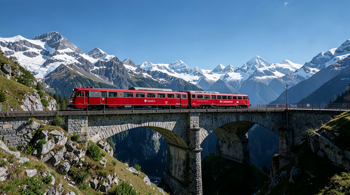
Similarly, the Rigi railways offer historical context through the operation of one of the oldest cogwheel routes from Vitznau to Rigi Kulm, providing panoramic vistas of the Lake Lucerne and Lake Zug regions 10. The maintenance of these tracks often involves specialized equipment designed to handle steep gradients and extreme seasonal conditions, ensuring that access remains consistent throughout the year for both tourists and local commuters 10.
Regional Rail Dynamics and Linguistic Diversity
The rail network acts as a bridge between Switzerland's four distinct language regions, reflecting the country's cultural diversity through its architectural and operational character. The Centovalli railway, for example, creates a scenic link between Locarno and Domodossola, characterized by deep, wooded valleys and stone viaducts that represent a different architectural aesthetic compared to the northern alpine routes 10. These regional lines are often less heavily traveled than the main express services, offering an alternative perspective on the country’s geography.
The Gotthard Panorama Express exemplifies this cultural connectivity by combining aquatic transit on Lake Lucerne with the historical Gotthard railway route toward Ticino 10. This multi-modal approach highlights the intentional integration of varied transit types to maximize scenic exposure, requiring careful coordination between boat departures and train arrivals, which are maintained through the centralized SBB scheduling authority 10.
Operational Considerations and Regulatory Oversight
Participating in a comprehensive Swiss rail tour necessitates an understanding of the infrastructure’s operational requirements. Reservations are often mandatory for the most popular panoramic carriages, as these are subject to capacity limits due to their specialized design 1. Travelers are advised that while the system is highly reliable, regional weather patterns can occasionally impact service on high-altitude mountain lines, requiring flexibility in day-to-day itinerary management 1.
Regulatory oversight is managed by national and regional transportation authorities, ensuring that safety standards, environmental protocols, and service levels remain consistent across all private and state-owned rail operators 10. This structured environment supports the viability of self-guided tours, as the consistency in signage, platform information, and inter-modal connectivity reduces the technical requirements for travelers navigating the country independently 11.
Conclusion: The Evolution of Scenic Rail Transit
The current state of train tours across Switzerland reflects a long-term investment in panoramic transit infrastructure. By bundling historic routes with modern engineering, the network provides a reliable, albeit complex, system for exploring the alpine landscape 1. As the industry continues to emphasize sustainable tourism, the reliance on these electrified rail systems remains a central component of Switzerland's environmental strategy, ensuring that the country’s natural assets are accessible without the reliance on private motorized transit 1.
Sources
- Travel Switzerland: The Grand Train Tour of Switzerland
- EF Go Ahead Tours: Switzerland by Train: Lucerne to Zurich
- Exotik Journeys: Grand Train Tour of Switzerland
- Tenon Tours: Switzerland by Train: A Guided Journey of Discovery
- Go Rail Travel: Majestic Switzerland: A Grand Panoramic Train Voyage
- Go Rail Travel: Scenic Switzerland: Glacier & Bernina Express Adventure
- Great Rail Journeys: GoldenPass, Mont Blanc & Jungfrau Express
- Go Rail Travel: Swiss Alpine Discovery – Scenic Rail & Mountain Highlights
- Jungfrau Tours: Golden Pass Classic
- SBB/General Information/Regional Operators
- Traveler Tips: Grand Train Tour Switzerland
Authored by MistyMountainView team