Best Rehabilitation Centers for Stroke Recovery in the United States: A Data-Based Review
Best Rehabilitation Centers for Stroke Recovery in the United States are identified through several different ranking systems and clinical program descriptions, rather than through one universal national list. The available evidence highlights major facilities including Shirley Ryan AbilityLab, Spaulding Rehabilitation Hospital, TIRR Memorial Hermann, Kessler Institute for Rehabilitation, Mayo Clinic, and Rusk Rehabilitation, while also showing why location, medical stability, therapy intensity, and insurance authorization affect individual suitability. 1
How national rehabilitation rankings are constructed
U.S. News lists 1,091 rehabilitation matches and places Shirley Ryan AbilityLab in Chicago at number one in its national rehabilitation hospitals ranking, with a score of 100.0 out of 100. The ranking is separate from a hospital’s stroke rating, because rehabilitation evaluates post-acute recovery performance while stroke ratings assess hospital treatment of stroke itself. U.S. News states that its stroke evaluation includes survival, recovery at home, patient volume, and related outcome measures. 1 2
Other published systems use different populations and methods. Statista and Newsweek’s 2025 project evaluated more than 1,200 centers and recognized 320 inpatient rehabilitation facilities, using professional surveys, Centers for Medicare & Medicaid Services quality metrics, accreditation information, and other data. A separate summary of U.S. News’ 2025 rehabilitation results reported that 1,049 facilities were evaluated, illustrating why rankings should be compared by methodology rather than treated as identical league tables. 3 4
Nationally recognized centers and their reported strengths
Shirley Ryan AbilityLab is identified by U.S. News as the leading national rehabilitation hospital, and earlier descriptions refer to its high stroke patient volume, speech-language services, support groups, and robot-assisted walking therapy. Spaulding Rehabilitation Hospital in Charlestown, Massachusetts, TIRR Memorial Hermann in Houston, Kessler Institute in New Jersey, and Rusk Rehabilitation at NYU Langone in New York also appear among widely cited national rehabilitation institutions. 1 5
Other prominent programs serve distinct clinical or geographic needs. Mayo Clinic in Rochester describes a coordinated stroke rehabilitation model involving neurology, physical therapy, and occupational therapy. Shepherd Center in Atlanta focuses on intensive stroke and neurological rehabilitation, while Craig Hospital in Englewood is known for neurological rehabilitation and longer-term recovery. MedStar National Rehabilitation Network provides stroke services in the Washington, D.C., region, and Mount Sinai describes a dedicated stroke recovery approach in New York. 5 6
What inpatient stroke rehabilitation typically includes
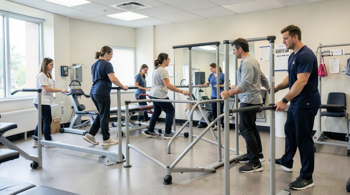
Stroke rehabilitation commonly addresses movement, communication, swallowing, cognition, and daily activities. Facility descriptions identify physical therapy for gait, balance, strength, coordination, transfers, and endurance; occupational therapy for dressing, bathing, grooming, fine motor skills, cognitive strategies, and home safety; and speech therapy for swallowing, language, articulation, voice, and cognitive-linguistic needs. These disciplines are usually coordinated around functional goals and a safe transition to the next care setting. 7 8
Intensity varies according to medical stability, endurance, neurological impairment, and the patient’s ability to participate. One Louisiana inpatient program describes therapy of approximately three hours per day, five days per week, while other facilities may structure treatment differently. Care can include nursing, medical oversight, counseling, caregiver education, assistive technology, and treatment for spasticity. The appropriate setting may be inpatient rehabilitation, outpatient therapy, or a continuing-care program. 7 9
Outcome measures and quality indicators
Reported national rehabilitation benchmarks provide context but do not predict an individual patient’s result. A 2025 summary cited a 93.1% rate for patients who were not readmitted to an acute-care hospital within 30 days after discharge, a 95.6% rate for patients who avoided transfer to acute care during rehabilitation, and a 65.4% rate for patients discharged directly home. These measures address utilization and discharge destination, not complete neurological recovery. 4
Quality review should therefore include more than a facility’s rank. Families can examine whether a program treats the relevant stroke effects, provides speech and swallowing assessment, coordinates medical and therapy care, measures functional progress, and plans for home safety. Accreditation is another relevant signal: CARF accreditation is reported by Orlando Health Advanced Rehabilitation Institute and by the West Jefferson Rehabilitation Center, although accreditation alone does not establish that a program is suitable for every patient. 7 10
Eligibility, timing, and practical access issues
Admission to intensive inpatient rehabilitation generally depends on medical stability and the ability to participate in a structured therapy program. Horizon Rehabilitation Hospital describes patients transferring from an acute-care hospital after stabilization, while Whittier Health Network describes a continuum involving acute care, intensive inpatient rehabilitation, and outpatient rehabilitation. Clinical teams must assess neurological deficits, cognition, swallowing, endurance, nursing needs, and the likely benefit of intensive therapy before recommending a setting. 8 6
Access can be limited by geography, bed availability, referral procedures, payer authorization, transportation, and the need for specialized medical services. A nationally ranked institution may be impractical when a patient requires proximity to family, local follow-up, or care for complex conditions outside the program’s principal expertise. Regional programs can provide comparable therapy disciplines and may offer a more workable continuum from inpatient care to outpatient treatment. 6 7
Risks, limitations, and questions for comparison
Stroke recovery is variable, and no ranking guarantees functional independence or a particular discharge destination. Patients may experience persistent weakness, impaired balance, speech or swallowing difficulty, cognitive changes, sensory problems, depression, or emotional frustration. Whittier’s clinical overview identifies these as common post-stroke challenges. Rehabilitation also involves fatigue, caregiver demands, medication management, home modifications, and continued therapy after discharge. 6
Useful comparison questions concern the program’s stroke volume, therapy disciplines, physician coverage, nursing capacity, swallowing and communication services, spasticity treatment, family training, discharge planning, accreditation status, and measured outcomes. It is also important to distinguish acute stroke treatment from post-acute rehabilitation, verify eligibility with the treating medical team, and clarify what services continue after discharge. These safeguards reduce the risk of choosing a facility solely because of a national label. 1 7 10
Sources
- U.S. News & World Report, Best Hospitals for Rehabilitation and Stroke Rankings
- U.S. News & World Report, Best Hospitals for Stroke
- Statista and Newsweek, America’s Best Physical Rehabilitation Centers 2025
- Facing Disability, 2025 Best Rehabilitation Hospitals Rankings
- GuideDoc, 5 Best Stroke Rehabilitation Centers in the United States
- Whittier Health Network, Stroke Rehabilitation Programs
- LCMC Health, Neurological Rehabilitation and Physical Medicine
- Horizon Rehabilitation Hospital, Stroke Rehabilitation Services
- Mayo Clinic, Stroke Rehabilitation
- Orlando Health Advanced Rehabilitation Institute, Comprehensive Inpatient Rehabilitation
Authored by MistyMountainView team