Yoga Sessions for Beginners: A Practical Evidence-Informed Guide
Yoga sessions for beginners do not need to be complicated, strenuous, or an hour long. Beginner practices described by Yoga Journal range from three to 20 minutes and include seated stretches, gentle floor movements, breathing, and accessible transitions, making it possible to begin at home or while traveling. 1
What a Beginner Yoga Session Typically Includes
A beginner session generally combines preparation, foundational postures, controlled breathing, and a gradual finish. Hatha yoga is frequently recommended for newcomers because its slower pace emphasizes basic postures and breath control. A conventional introductory class may last 45 to 60 minutes, although shorter sessions can reduce the practical barrier created by limited time or unfamiliarity. 2 The appropriate length depends on the participant's schedule, energy, mobility, and ability to remain attentive.
- Short sessions may last three, five, 10, or 15 minutes.
- A 20-minute sequence can address the spine, hips, shoulders, and general mobility.
- Longer introductory classes commonly include warm-up and cool-down periods.
- A mat is useful but not essential for every floor-based routine.
Foundational Movements and Postures
Common beginner movements include Mountain Pose, Child's Pose, Cat and Cow, Downward-Facing Dog, seated neck stretches, forward folds, low lunges, and gentle twists. Yoga Journal's 10-minute morning sequence includes Child's Pose, Cat and Cow, High Lunge, Chair Pose, and seated stretches, while its 15-minute practice begins with neck and shoulder work before moving into spinal twists, side bends, kneeling stretches, and low lunges. 3 These sequences emphasize familiarity and controlled movement rather than advanced flexibility.
- Mountain Pose: establishes a standing reference for posture and balance.
- Child's Pose: provides a lower-to-the-floor shape that can be adjusted through knee width and arm position.
- Cat and Cow: links spinal movement with inhalation and exhalation.
- Low Lunge: introduces hip and leg mobility without requiring a deep range of motion.
Choosing a Session Length and Format
Different formats address different starting points. A three-minute routine can consist of a neck stretch, a cross-legged forward fold, and a seated twist. A five-minute class may combine a gentle flow with breathing and meditation. A 10-minute morning routine can include upper-body mobilization, Cat and Cow, Child's Pose, lunges, a standing sequence, and a quiet finish. A 10-minute floor-based practice can also be performed on a mat or in bed without standing. 4
| Format | Typical focus | Useful context |
|---|---|---|
| 3 minutes | Simple full-body stretching | Low motivation or a brief pause |
| 5 minutes | Movement, breathing, meditation | A compact daily routine |
| 10 minutes | Mobility, balance, strength, or floor work | Morning, travel, or home practice |
| 15 to 20 minutes | More complete full-body sequencing | A structured beginner session |
Breathing, Pace, and Modifications
Breathing is a central part of beginner instruction, but it should remain comfortable rather than forced. The supplied beginner routines pair gentle movement with long, slow breaths and encourage participants to move at their own pace. One home sequence recommends beginning with three unhurried breaths, softening the jaw and shoulders on each exhale, and observing stiffness and energy before selecting an intensity. 5 Mindful breathing is also identified as a more appropriate early priority than attempting perfect form during the first weeks.
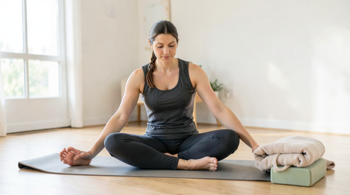
- Move slowly enough to notice changes in balance, tension, and comfort.
- Use a smaller range of motion when a posture feels demanding.
- Choose seated or lying positions when standing is uncomfortable.
- Blocks, straps, blankets, cushions, and bolsters can modify positioning and provide support.
- Stop or change a movement if discomfort increases rather than easing with adjustment.
Potential Benefits and Evidence Limits
Research summarized in the supplied material reports several possible benefits, although outcomes vary by person and practice. An Agency for Healthcare Research and Quality report evaluated eight yoga trials involving 1,466 participants and found short-term and intermediate-term improvements in low-back pain and function. A separate 2017 review of three studies involving 188 participants reported short-term benefits for neck-pain intensity and related disability. 6 These findings support cautious expectations rather than a guarantee of symptom relief.
A national survey of more than 1,000 yoga practitioners found that 86.5% reported improved happiness and 68.5% reported improved sleep. The supplied health guidance also describes evidence that yoga may reduce cortisol and improve cardiovascular health markers in new practitioners. 7 Such findings should be interpreted alongside study design, individual health status, and the difference between a survey association and a confirmed cause.
Building a Sustainable Beginner Routine
Consistency is more important than selecting an ambitious session that cannot be maintained. Clinical guidance summarized in the research associates practicing two to three times per week with improved flexibility and stress reduction. 8 A practical routine can alternate short sessions with longer practices, depending on energy and available time. Repeating familiar sequences also allows beginners to observe posture, breathing, and comfort without adding unnecessary complexity.
- Start with a session length that feels manageable rather than imposing.
- Keep clothing stretchy and moisture-wicking so movement is unrestricted.
- Consider an introductory workshop when alignment or injury prevention is difficult to assess alone.
- Group classes may provide social support, which is associated with stronger retention in new exercise routines.
- Track attendance and comfort, not advanced poses or appearance.
Safety Considerations and Practical Boundaries
Yoga is not risk-free, and a beginner's ability to modify a posture does not remove every health consideration. The supplied evidence specifically advises people with a back or neck condition to consult a doctor before beginning. Introductory instruction should explain alignment and injury prevention, while props can make positions more accessible across different fitness levels. 9 Pain, dizziness, or worsening symptoms are reasons to stop the movement and seek appropriate professional guidance.
There is no single eligibility standard for beginning a gentle yoga session, but comfort, medical context, and supervision matter. A person returning after a hiatus, experiencing stiffness, or practicing with low motivation may select a floor-based sequence, while someone comfortable standing may use Mountain Pose, Chair Pose, or a low-intensity lunge. The central boundary is that yoga should be adapted to the participant, not performed to satisfy an external standard of flexibility or depth. 10
Sources
- Yoga Journal, 15-Minute Yoga for Beginners You Can Do at Home
- Yoga Journal, Hatha Yoga overview
- Yoga Journal, 10-Minute Morning Yoga Poses for Beginners
- Yoga Journal, 10-Minute Gentle Yoga for Beginners
- Yogas.live, 10-Minute Morning Yoga for Beginners
- Yoga.com, Full-Body Beginner Yoga Sequence
- National Center for Complementary and Integrative Health, Yoga: What You Need to Know
- Cleveland Clinic, Benefits of Yoga
- Yoga Alliance, About Yoga
- Healthline, Benefits of Yoga and the Use of Props
Authored by MistyMountainView team