Natural approaches for soothing sore shoulder joints: An evidence-informed review
Natural approaches for soothing sore shoulder joints include heat or cold therapy, gentle range-of-motion exercises, posture changes, and complementary options such as acupuncture. Shoulder discomfort can arise from overuse, bursitis, tendinitis, arthritis, muscle strain, frozen shoulder, or referred pain from the neck, so the safest approach depends on the underlying cause. The shoulder is highly mobile but supported by a relatively small socket and a network of muscles and tendons, which helps explain its vulnerability to irritation and injury. 123
Start with the likely pattern of pain
Mild shoulder soreness after repetitive movement, sports, lifting, or an awkward position may respond to activity modification while comfortable movement is maintained. Avoiding painful overhead work and heavy lifting can reduce additional strain, but prolonged complete rest may contribute to stiffness. Pain that develops gradually with restricted movement can occur with frozen shoulder, while swelling and widespread symptoms may be associated with conditions such as rheumatoid arthritis or polymyalgia rheumatica. These different patterns should not be treated as interchangeable. 23
The shoulder contains the glenohumeral ball-and-socket joint and the acromioclavicular joint, along with cartilage, synovium, tendons, muscles, and bursae. Problems in any of these structures can produce similar everyday complaints, including difficulty reaching, lifting, dressing, or sleeping on the affected side. A clinical assessment becomes particularly important after trauma, when movement is substantially limited, or when shoulder pain may actually originate in the neck, upper back, or another part of the body. 36
Use heat and cold according to the situation
Cold therapy is generally used after a new injury or during an inflammatory flare-up, while heat is more often used for stiffness or tight muscles. A cloth barrier should separate ice or a cold pack from the skin, and either treatment should be limited to short intervals rather than applied continuously. These methods primarily aim to improve comfort and reduce perceived symptoms; they do not establish or correct the cause of shoulder pain. 58
Heat may help relax muscles and make gentle movement more comfortable, whereas cold may lessen swelling and irritation following acute strain. The response is individual, so worsening pain, skin irritation, or increased stiffness is a reason to stop the application. Heat and cold can be considered supportive measures alongside appropriate movement, not substitutes for evaluation when symptoms persist, recur, or follow a significant injury. 57
Preserve mobility with gentle movement
Pendulum exercises, shoulder rolls, and controlled range-of-motion movements are commonly used to preserve mobility in a stiff shoulder. Wall crawls can provide another gradual way to move the arm upward, provided the movement remains within a comfortable range. Gentle exercise should not be forced through sharp or escalating pain. The objective is regular, controlled motion that limits stiffness while avoiding the repetitive loading that may have triggered the original soreness. 210
Stretching can support mobility in the shoulder and upper back, but technique and diagnosis matter. A person with a suspected tendon injury, dislocation, severe inflammation, or frozen shoulder may require a tailored rehabilitation plan rather than an identical home routine. Strengthening the muscles around the shoulder is also used in recovery, including controlled resistance-band or light-weight exercises, although progression should be guided by tolerance and, where needed, a qualified clinician. 610
Reduce mechanical strain through posture and habits
Posture changes can reduce repeated loading around the neck, upper back, and shoulder. Slouching or hunching during desk work may increase tension, while more neutral sitting and standing alignment can reduce unnecessary strain. Activity modification includes changing repetitive tasks, avoiding painful overhead movements, supporting the arm on a cushion while seated, and avoiding sleep directly on the sore shoulder. These measures are practical because they address repeated mechanical triggers rather than only masking discomfort. 28
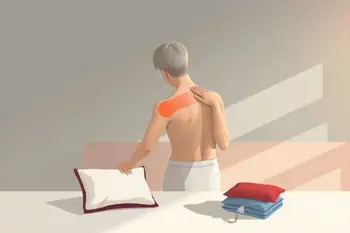
Correct posture is not a universal cure, and it should not be used to explain every shoulder problem. Osteoarthritis, rotator-cuff irritation, bursitis, trauma, and systemic inflammatory disease can require different care. The shoulder is used constantly in reaching, pulling, lifting, sport, and work, so improvement may depend on adjusting the specific activity that aggravates symptoms. A symptom diary describing movements, timing, stiffness, and functional limits can help clarify those patterns during assessment. 23
Consider complementary therapies cautiously
Acupuncture is among the complementary therapies studied for shoulder pain, particularly frozen shoulder. A 2025 systematic review and network meta-analysis examined randomized controlled trials of acupuncture-related therapies and reported that overall effectiveness remained uncertain, despite potential benefits being investigated. A 2026 scoping review of self-care for chronic neck and shoulder pain also identified traditional, complementary, and alternative practices, while emphasizing the need to interpret the varied evidence base carefully. 14
TENS is a non-invasive method intended to influence pain signalling and may temporarily mask discomfort rather than resolve structural damage. Yoga and qigong may be used for controlled movement, relaxation, and upper-back or shoulder alignment, but poses should be modified if they reproduce pain. Traditional practices such as acupressure and herbal applications are described in wellness literature, yet individual reports or traditional use do not demonstrate clinical effectiveness. 1111213
Review supplements and topical remedies critically
Turmeric and curcumin are commonly discussed for their possible anti-inflammatory effects, while topical capsaicin may reduce the sensation of joint pain through repeated local use. These approaches should be viewed as symptom-management possibilities, not confirmed treatments for every shoulder condition. The cited evidence concerns biological mechanisms or pain relief more broadly and does not prove that a supplement or cream will repair a rotator-cuff tear, reverse arthritis, or restore a frozen shoulder. 67
Magnesium supplements and Epsom salt baths are also frequently suggested for muscle relaxation, but the evidence supplied for shoulder pain is limited compared with the practical advice on movement, heat, cold, and posture. An ethnobotanical study in Ilam, Iran, documented 11 medicinal plant species reported by 25 traditional healers, while noting that plant-based treatments lacked proper documentation. That survey records local knowledge, not proof of safety, dosage, quality, or effectiveness for individual patients. 1914
Know when self-care is not enough
Shoulder pain that follows a dislocation, separation, blow, or other substantial trauma warrants professional evaluation rather than stretching alone. Assessment is also appropriate when pain is severe, movement is markedly restricted, symptoms continue, or daily activities and sleep remain affected. Arthritis UK notes that shoulder symptoms can occur as part of osteoarthritis, rheumatoid arthritis, or polymyalgia rheumatica, while clinical guidance also recognizes that pain may be referred from the neck or may signal a serious non-shoulder problem. 38
The central safety principle is to use natural measures as conservative support while monitoring function and symptom progression. Gentle movement should remain comfortable, topical products should be stopped if they irritate the skin, and herbal or supplement use should be discussed with a qualified healthcare professional when medical conditions or ongoing treatments are present. Evidence is strongest for practical symptom relief and mobility support, whereas many traditional, supplement-based, and device-based approaches require more condition-specific research. 14
Sources
- MDPI, Traditional, Complementary, and Alternative Medicine for Self-Care in Chronic Neck and Shoulder Pain: A Scoping Review
- Harvard Health Publishing, Best Shoulder Pain Treatments and Tips
- Arthritis UK, Shoulder Pain: Symptoms, Causes and Treatment
- Frontiers in Medicine, Comparative Effectiveness of Acupuncture-Related Therapies for Frozen Shoulder
- Cleveland Clinic, Hot and Cold Therapy
- Arthritis Foundation, Capsaicin for Arthritis Pain
- National Institutes of Health, Curcumin Research Review
- Mayo Clinic, Shoulder Pain Diagnosis and Treatment
- WebMD, Epsom Salt Bath Information
- Verywell Health, Stretches for Shoulder Pain
- Healthline, TENS Unit for Shoulder Pain
- The Tao of Healing with Chenxi, Natural TCM Methods for Shoulder Pain
- Yoga Journal, Yoga for the Shoulders
- Journal of Biochemistry and Phytomedicine, Medicinal Flora and Local Knowledge on Shoulder Pain Relief in Ilam City
Authored by MistyMountainView team