Yoga Classes for Beginners: A Comprehensive Guide to Foundational Practices
Entering the practice of yoga can often feel daunting, yet a variety of resources exist to facilitate an accessible transition into this discipline 1. Whether through local studio series or brief, targeted home routines, beginners are increasingly encouraged to approach the practice as a systematic development of body awareness rather than a pursuit of physical performance 2. This report outlines the standard structures, pedagogical approaches, and considerations for individuals initiating their movement journey 3.
Foundational Styles and Learning Approaches
For those new to the practice, Hatha yoga is frequently identified as an ideal starting point because it emphasizes foundational postures and a deliberate, slower pace 4. In contrast to more dynamic, high-intensity styles, Hatha allows practitioners to focus on breathwork and structural alignment 5. Similarly, Iyengar yoga offers a methodology centered on precision, frequently utilizing props such as blocks and straps to assist students in holding postures with correct alignment, which is critical for injury prevention 6.
Educational structures for beginners often take the form of multi-week series. For example, some programs provide an 8-week progressive curriculum that introduces basic alignment and breathing techniques one step at a time, moving away from intimidating or overly complex sequences 7. Other formats, such as a 4-week series, may combine foundational sessions with a single all-levels class to help students bridge the gap between isolated learning and broader community practice 8.
Classroom Structure and Expectation Management
Professional instruction for beginners typically spans 60 to 90 minutes, though condensed sessions of 10 or 15 minutes are increasingly common for home-based habit building 9. A typical hour-long session usually incorporates a settling period for arrivals, introductory breath awareness known as pranayama, gentle warm-up movements, and a final relaxation period, or Savasana, to integrate the physical and mental efforts of the session 10. The goal is often to establish a sustainable habit that supports stress relief and mental clarity rather than physical mastery 11.
Classes are designed to be inclusive, frequently noting that no prior experience or extreme flexibility is required for participation 12. Many programs, including those found in academic or community-based settings, emphasize that classes are adaptable for various body types and levels of physical fitness 13. However, participants should be aware that some studios have specific medical disclaimers; individuals recovering from recent surgeries or those relying on mobility aids may be directed toward specialized options like chair yoga to ensure a supportive environment 14.
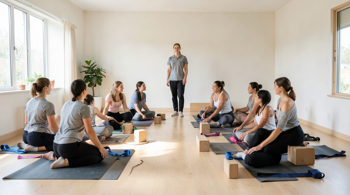
The Role of Props and Supportive Equipment
Props serve as essential tools for the beginner to safely navigate transitions and maintain alignment in various postures 15. Utilizing blocks, straps, and bolsters allows individuals to bridge the gap between their current range of motion and the requirements of a pose, effectively reducing the risk of strain 16. Proper utilization of these tools is a hallmark of safe instruction, allowing practitioners to modify their engagement according to their unique physical requirements 17.
| Prop Category | Primary Purpose for Beginners |
|---|---|
| Yoga Blocks | Supports alignment in seated or standing poses |
| Straps | Assists in extending reach during forward folds |
| Bolsters | Provides cushioning for restorative or seated postures |
Integrating Mindfulness and Breathwork
Foundational yoga is rarely limited to physical exertion; it is a system that integrates breath with movement to settle the nervous system 18. Techniques introduced to beginners include simple breathing exercises designed to support energy regulation and inner balance 19. By focusing on the connection between the body and breath, practitioners learn to manage stress levels effectively. Guided relaxation techniques are also standard components of beginner courses, helping to release both physical tension and mental fatigue accumulated during daily life 20.
Practical Considerations for Starting
Preparation for a beginner class involves minimal specialized equipment, usually requiring only comfortable, breathable clothing and a standard mat 21. Most institutions and local providers encourage a mindset shift, advising students not to focus on the end result of a posture but rather on the consistency of the practice itself 22. Regular attendance at structured courses-whether in a small group setting or through guided daily routines-helps students build the confidence to transition into broader, all-level community classes over time 23.
Regulatory and Safety Oversight
As with any physical activity, awareness of personal health limitations is a critical aspect of responsible practice. Research underscores that beginners should seek guidance on injury prevention and adhere to the principle of incremental progress to avoid overexertion 24. When selecting a class, it is prudent to note that many community education programs operate with minimum enrollment requirements and may cancel or reschedule sessions if those metrics are not reached 25. Prospective students should verify facility policies regarding cancellation, participant requirements, and instructional qualifications before committing to a series.
Sources
- Yoga Journal: 15-Minute Yoga for Beginners
- Charlotte Yoga: CY101 Beginner Yoga Class
- Sivananda Yoga India: Beginners’ Yoga Course
- Yoga Journal: Types of Yoga (Hatha Yoga Overview)
- Yoga International: Pranayama for Beginners
- MindBodyGreen: Iyengar Yoga Basics
- myPelham: Intro to Yoga Series
- Breathe Easy Therapy: 4-Week Beginner Yoga Series
- Yoga Journal: 10-Minute Morning Yoga Poses
- Pathway to Calm: Friday Morning Yoga
- Mayo Clinic: Stress Management Through Yoga
- Texarkana College: Beginner Yoga Class Overview
- YMCA: Healthy Living and Fitness Programs
- Purna Yoga 828: Start Yoga Now Series
- Verywell Fit: Essential Yoga Props for Beginners
- NIH: Yoga – What You Need to Know
- Alo Moves: Beginner Yoga Series
- Everyday Health: Yoga for Beginners Guide
- Healthline: Preparation for Your First Yoga Class
- National Institutes of Health: Safety and Injury Prevention
Authored by MistyMountainView team