Best hinged knee braces for daily mobility support: A clinical comparison of fit, stability, and daily-use considerations
Best hinged knee braces for daily mobility support are not defined by one universal design. The relevant choices range from breathable wraparound supports for mild instability to adjustable medical orthoses for ligament rehabilitation, arthritis, meniscal conditions, or hyperextension control. The comparison below focuses on documented features, intended uses, fitting considerations, and limitations rather than treating any single brace as appropriate for every knee condition.
How hinged braces support daily mobility
Hinged knee braces use side supports to provide medial and lateral stability while allowing the knee to bend. The AliMed MultiLock design, for example, uses bilateral plastic hinges with separate adjustable pin stops, with range of motion adjustable from 0 to 90 degrees in 15-degree increments. Its stated purpose includes limiting hyperextension while preserving movement for everyday activities or athletics. 1
Polycentric hinges are another common design. The Ossur Rebound wraparound brace uses low-profile polycentric hinges with malleable arms, while the DonJoy Playmaker Xpert combines removable polycentric hinges with an open patella and adjustable construction. These features are intended to balance stabilization with movement, but the level of control remains different from a rigid, double-upright rehabilitation brace. 23
Options for arthritis, meniscal conditions, and instability
The Bauerfeind GenuTrain S Pro is positioned for arthritis, instability, and meniscal injuries. Its documented design includes medial and lateral adjustable hinges, a three-dimensional knitted compression material, and a viscoelastic patella insert. The hinge settings allow flexion controls at 30, 60, or 90 degrees and an extension limit of 20 degrees, making the brace more configurable than a basic compression support. 4
The GenuTrain S is also described for moderate ligament disorders, knee instability, meniscal conditions, and tricompartmental osteoarthritis. Bauerfeind Partners identifies class 2 medical compression at 24 mmHg and notes that customized versions may be arranged through a representative. Such specifications indicate a more structured clinical support category, where diagnosis, side selection, and professional fitting can matter as much as hinge construction. 5
Daily comfort and practical wear
Breathability and application method are central daily-use issues. The Ossur Rebound uses a three-layer CoolTech fabric described as breathable and fast drying, with a contoured popliteal area intended to reduce bunching behind the knee. The OrthoActive Airflex support similarly uses a breathable, moisture-wicking material and removable side hinges, reflecting a lighter approach for users who need compression and medial-lateral support without excessive bulk. 67
Wraparound construction can be useful when swelling, tenderness, or limited flexibility makes a pull-on sleeve difficult to apply. The Swede-O Front Close brace uses front closure straps, removable aluminum hinges, and removable buttress pads for patellar tracking. Its neoprene construction provides compression and warmth, although warmth may be less comfortable than breathable fabric during prolonged wear or in hot conditions. 8
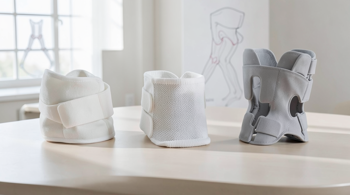
Brace categories by support requirement
| Support need | Documented design features | Practical consideration |
|---|---|---|
| Mild instability | Low-profile polycentric hinges and breathable fabric | Prioritizes mobility and comfort |
| Ligament recovery | Malleable rigid hinges or double uprights | Requires careful sizing and alignment |
| Restricted motion | Adjustable flexion and extension stops | Settings should reflect clinical guidance |
| Hyperextension | Posterior air bladder or hinge controls | Walking mechanics and fit are important |
The Ossur Formfit is described for mild to moderate ACL, PCL, MCL, and LCL strains or tears. It offers removable hinge arms that can be shaped to match anatomy, an open popliteal area, and sleeve or wrap styles in sizes from extra small through 3XL. This category may suit users needing more contouring than a soft sleeve, but malleable hinges still require correct positioning to deliver consistent support. 9
Hyperextension and gait-related considerations
Hyperextension requires a different assessment from ordinary side-to-side instability. The Guardian HXR Rehabilitator uses a pneumatic air bladder behind the knee to resist backward movement after full extension. Its documented design also includes dual hinges and an 18-inch heat-moldable aluminum frame intended to maintain position during standing and walking. This is a specialized construction rather than a general-purpose everyday sleeve. 10
Brace settings can affect how a person walks, particularly when extension or flexion is restricted. The GenuTrain S Pro provides defined hinge stops, while the Brace Align Apex uses extension settings from 0 to 25 degrees and flexion settings from 0 to 90 degrees. The Apex also uses double aluminum uprights and left-or-right configuration for ACL, MCL, PCL, and LCL support. These features increase control but also increase fitting complexity. 11
Fit, risks, and maintenance realities
Thigh measurement is repeatedly specified in the product data as a sizing method. The Rebound and Formfit instructions measure circumference six inches above the kneecap, while the DonJoy Playmaker Xpert uses a point approximately 15 centimeters above the patella. The DonJoy model is available in seven sizes and can be worn on either leg. Following the specific manufacturer chart is important because a loose brace may migrate and an overly tight brace may become uncomfortable. 12
Professional assessment remains important when pain, instability, post-operative restrictions, or suspected ligament injury is involved. Over-bracing may contribute to dependence or reduced muscle use, while an unsuitable hinge setting can restrict natural gait or fail to control the intended movement. Ongoing checks should include skin irritation, strap condition, hinge alignment, migration, and changes in swelling. AliMed also identifies its MultiLock product as intended for clinical purchasers, illustrating that access and suitability can vary by device category. 13
Sources
- AliMed, Knee Brace with MultiLock Polyamide Hinge
- Brace Direct, Ossur Rebound Knee Brace Wrap
- MedicalSupplies.co.uk, DonJoy Playmaker Xpert Hinged Knee Support
- Brace Direct, Bauerfeind GenuTrain S Pro Knee Brace
- Bauerfeind Partners, GenuTrain S Hinged Knee Brace
- Brace Direct, Ossur Rebound Knee Brace Wrap
- Okotoks HC Pharmacy, OrthoActive Airflex Hinged Knee Support
- Core Products, Swede-O Front Close Knee Brace with Hinges
- Brace Direct, Ossur Formfit Hinged Knee Brace
- Brace Direct, Guardian HXR Rehabilitator Knee Brace
- Brace Direct, Brace Align Apex ACL Stabilizer
- MedicalSupplies.co.uk, DonJoy Playmaker Xpert Hinged Knee Support
- AliMed, Knee Brace with MultiLock Polyamide Hinge
Authored by MistyMountainView team