Train tours in Switzerland: A factual guide to scenic routes, rail passes, and mountain excursions
Train tours in Switzerland are commonly organized around scenic railways that connect Alpine landscapes, lakeside towns, historic routes, and mountain excursions. The Grand Train Tour of Switzerland links major highlights across approximately 1,280 kilometers, while shorter itineraries focus on individual lines such as the Glacier Express, Bernina Express, GoldenPass Express, or Gotthard Panorama Express. 1
How the Grand Train Tour is structured
The Grand Train Tour is not a single fixed departure or mandatory sequence. Switzerland Tourism describes it as a flexible round trip combining the country’s most scenic railway lines, with routes, direction, and duration adaptable to the traveler’s itinerary. The network can combine trains with buses, boats, city transport, accommodation, and mountain railways, allowing travelers to emphasize cities, lakes, Alpine villages, or panoramic journeys. 1
Typical planning centers on a series of regional clusters rather than one continuous train ride. Lake Lucerne, the Lavaux vineyards, the Gotthard route, the Bernese Oberland, Zermatt, St. Moritz, and the route toward Tirano can be connected in different combinations. This flexibility also means that travel time, overnight locations, and reservations must be checked individually rather than assumed from the tour’s overall distance. 1
Major panoramic railways
Four named routes form the core of many Swiss rail itineraries. The Glacier Express links Zermatt and St. Moritz in approximately eight hours, crossing 291 bridges and passing through 91 tunnels. The Bernina Express travels between Switzerland and Italy through the Albula and Bernina landscapes, while the GoldenPass Express provides a direct panoramic connection between Interlaken and Montreux. 2 3 5
| Route | Documented characteristics |
|---|---|
| Glacier Express | Zermatt to St. Moritz, about eight hours, 291 bridges, and 91 tunnels. |
| Bernina Express | Swiss route toward Tirano in Italy through the Albula and Bernina landscapes. |
| GoldenPass Express | Direct panoramic service between Interlaken and Montreux. |
| Gotthard Panorama Express | Lake Lucerne boat travel combined with rail travel over the historic Gotthard route toward Ticino. |
Engineering, heritage, and landscape
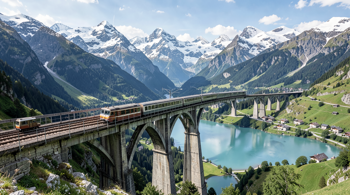
The Bernina journey is significant not only for scenery but also for railway heritage. UNESCO recognizes the Albula and Bernina railway landscape as a World Heritage property because of its technically advanced engineering and Alpine setting. The route demonstrates how rail infrastructure was integrated into steep mountain terrain while preserving a continuous visual relationship with glaciers, valleys, lakes, and villages. 4
The Gotthard Panorama Express presents a different form of scenic travel by combining a boat journey on Lake Lucerne with a train ride over the historic Gotthard mountain route toward Ticino. This intermodal format illustrates a defining feature of Swiss rail touring: the journey may involve several forms of public transport in a single itinerary, rather than relying exclusively on panoramic carriages. 6
Mountain excursions connected to rail tours
Many train itineraries add short mountain railway excursions at major bases. Jungfraujoch services reach Europe’s highest railway station at 3,454 meters above sea level, while the Gornergrat Railway climbs from Zermatt to 3,089 meters and provides views toward the Matterhorn and surrounding Alpine peaks. These excursions are separate experiences from long-distance panoramic trains and require attention to elevation, weather, and operating information. 7 8
- Jungfraujoch is reached by railway services in the Jungfrau region and is associated with high-altitude glacier and mountain viewpoints. 7
- Gornergrat is accessed from Zermatt by cogwheel railway and is associated with views of the Matterhorn. 8
- Additional itineraries may include Rigi, Mount Pilatus, or other mountain railways, depending on the selected route and schedule. 1
Passes, reservations, and planning constraints
The Swiss Travel Pass provides unlimited travel on much of the Swiss Travel System network for selected consecutive validity periods, including trains, buses, and boats. It does not remove every planning requirement: some panoramic services require seat reservations or supplements, and mountain excursions can have separate conditions. The applicable route, validity date, reservation status, and supplement should therefore be checked before travel. 9
Swiss Federal Railways provides timetable and ticket-planning tools for rail journeys throughout Switzerland, including connections used by scenic itineraries. Timetables matter because panoramic services, connecting trains, lake boats, and mountain railways may operate on different schedules. Weather, seasonal operations, luggage transfers, and overnight arrangements can also affect the practical sequence of a multi-stop tour. 10
Common itinerary formats and trade-offs
Organized examples show that Swiss train tours range from approximately eight-day regional journeys to ten-day or fifteen-day country-wide programs. A ten-day guided itinerary may combine Zurich, St. Moritz, Zermatt, Montreux, and Lucerne with first-class rail travel, hotel stays, luggage transfers, and reserved seats on selected scenic trains. A longer format can add Interlaken, Jungfraujoch, Lausanne, Lugano, and Lucerne. 3 6
Independent travel offers greater control over direction, stop length, and the balance between rail journeys and sightseeing. Guided travel can reduce the administrative burden through tour-manager support, scheduled transfers, and coordinated accommodation, but it usually follows a predefined timetable and group structure. Both formats involve trade-offs between flexibility, assistance, time spent changing locations, and the number of excursions included. 3 6
Practical risks and what to verify
The principal friction points are not limited to train travel itself. Mountain weather can affect visibility and excursion conditions, high-altitude destinations may be unsuitable for some travelers, and panoramic routes may require advance seat reservations. International segments such as the Bernina Express journey toward Tirano also require attention to border-crossing arrangements and the itinerary’s transport validity. 3 9
Travelers should distinguish between a route description and a confirmed operating schedule. Departure times, seasonal services, reservation rules, luggage arrangements, accommodation, and included meals vary by itinerary provider. Official railway and transport sources remain the appropriate references for current timetables and conditions, while tour descriptions are useful for comparing the sequence of destinations and the level of guidance provided. 9 10
Sources
- Switzerland Tourism, The Grand Train Tour of Switzerland
- Glacier Express
- Rhaetian Railway, Bernina Express
- UNESCO World Heritage Centre, Albula/Bernina Landscapes
- GoldenPass Express
- Gotthard Panorama Express
- Jungfrau Railways, Jungfraujoch
- Gornergrat Railway
- Swiss Travel System
- Swiss Federal Railways
Authored by MistyMountainView team