Warning signs of multiple sclerosis: A clinical guide to early symptoms
Painful vision loss, facial paralysis, limb weakness, and persistent dizziness are possible warning signs that warrant medical assessment, although none of these symptoms alone confirms multiple sclerosis. Early symptoms often develop over hours or days, last longer than 24 hours, worsen before improving, and may be followed by a period of relative recovery. 1
How multiple sclerosis symptoms develop
Multiple sclerosis is an immune-mediated disease affecting the central nervous system, particularly the brain, spinal cord, and optic nerves. The immune system damages myelin, the protective covering around nerve fibers, disrupting signals between the brain and body. Because different nerve pathways can be affected, symptoms vary substantially between individuals. 2
A commonly reported pattern is a flare followed by remission. Symptoms may appear suddenly, persist for days to months, and then improve, leaving relatively good health between episodes. Over time, some people experience gradually increasing disability, while others have distinct relapses separated by longer intervals. 3
- Symptoms can involve more than one body system, including vision, sensation, movement, and bladder control. 4
- There is no single classic early presentation that applies to every person. 5
Vision changes and optic neuritis
Optic neuritis is one of the more recognizable early presentations of MS. It can cause blurred or reduced vision in one eye, pain during eye movement, and changes in color perception. Some people describe the affected vision as dim, washed out, or as though they are looking through a veil. 1
Vision symptoms may be particularly concerning when they are new, affect one eye, develop over hours or days, and last beyond a brief episode. Abnormal eye movements and other visual or oculomotor problems can also occur because MS lesions may affect pathways that coordinate eye movement. 6
- Pain that becomes worse when the eye moves can accompany optic neuritis. 1
- New vision loss should be assessed promptly because several conditions can affect the optic nerve or retina. 5
Numbness, tingling, and electrical sensations
Numbness, tingling, burning, or pins-and-needles sensations are common neurological complaints associated with MS. They may occur in the face, arms, legs, or trunk and can affect one side or several areas. Sensory symptoms may be subtle at first, but persistent or spreading changes can interfere with walking, balance, and fine motor tasks. 4
Lhermitte’s sign is another reported sensory symptom. It is described as an electrical-shock sensation that travels down the spine, sometimes into the arms or legs, when the neck bends forward. This sign is associated with irritation of pathways in the cervical spinal cord, but it is not exclusive to MS. 7
- New sensory symptoms that last more than 24 hours fit the pattern clinicians may investigate as a neurological episode. 1
- Similar sensations can arise from conditions other than MS, so symptom history and examination are important. 5
Weakness, stiffness, and coordination problems
Motor warning signs can include limb weakness, clumsy movements, muscle stiffness, spasms, difficulty walking, and loss of balance. These problems may result when lesions interfere with pathways that control strength, posture, and coordination. A person may notice tripping, dropping objects, difficulty climbing stairs, or unusual stiffness in one or more limbs. 6
Persistent dizziness or vertigo can occur when MS affects nerve pathways involved in balance and spatial orientation. Facial weakness or paralysis and difficulty speaking are also neurological symptoms that require assessment, particularly when they appear with limb weakness, coordination changes, or other central nervous system signs. 1
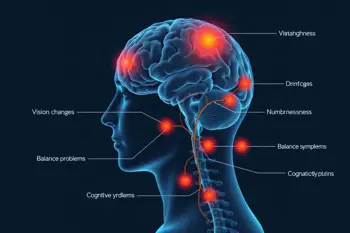
- Walking difficulty, worsening weakness, and trouble maintaining balance are reasons to arrange medical evaluation. 5
- Sudden severe weakness, speech difficulty, or facial drooping can also indicate other urgent neurological conditions and should not automatically be attributed to MS. 8
Fatigue and cognitive changes
MS-related fatigue is often described as overwhelming exhaustion that is disproportionate to recent physical activity. It can limit work, household tasks, concentration, and mobility. Fatigue is common among people with MS, but it is nonspecific and may also accompany sleep disorders, mood conditions, infections, anemia, medication effects, and other illnesses. 8
Cognitive changes may involve memory, attention, processing speed, verbal fluency, or the ability to think clearly. These experiences are sometimes called brain fog. Cognitive symptoms can be mild and may fluctuate, making them difficult to distinguish from ordinary tiredness without a broader neurological history and examination. 4
- Fatigue becomes more clinically informative when it occurs alongside objective neurological symptoms such as numbness, weakness, or visual changes. 5
- Cognitive complaints alone do not establish an MS diagnosis. 6
Bladder, bowel, and other nervous-system symptoms
Damage to spinal cord or brain pathways can contribute to urinary urgency, frequent urination, difficulty emptying the bladder, or incontinence. Bowel changes and sexual dysfunction are also reported. These symptoms can substantially affect daily routines, but they have many possible causes, including infections, pelvic disorders, medications, and other neurological diseases. 6
Heat sensitivity is another symptom reported by some people with MS. Increases in body temperature may temporarily worsen existing neurological symptoms. Muscle spasms, pain, mood disturbances, and difficulty speaking may also occur. The combination, duration, and distribution of symptoms are more informative than any isolated complaint. 8
- Bladder or bowel changes accompanied by leg weakness, numbness, or walking difficulty warrant neurological assessment. 4
- Symptoms that recur in separate episodes or affect different parts of the central nervous system may prompt further investigation. 3
When evaluation is needed and how diagnosis works
One symptom or even several symptoms do not prove that a person has MS. Many disorders can resemble it, and there is no single definitive laboratory test. Clinicians use the medical history, neurological examination, and testing to determine whether symptoms are consistent with lesions separated in location and time. 5
MRI of the brain and spinal cord is central to the diagnostic process. Professional diagnostic descriptions refer to clinical or MRI evidence of characteristic lesions in multiple central nervous system locations and at different times. Depending on the case, clinicians may use additional tests to evaluate alternative explanations before confirming a diagnosis. 6
- New vision loss, persistent weakness, worsening walking difficulty, or significant coordination problems merit prompt medical attention. 1
- Emergency assessment is appropriate for sudden neurological deficits because stroke and other acute conditions can resemble MS symptoms. 8
Sources
- Cleveland Clinic, “Don’t Ignore These Possible Early Signs of Multiple Sclerosis”
- MS-UK, “Is it MS? Here are some common MS symptoms”
- Merck Manual Consumer Version, “Multiple Sclerosis (MS)”
- Multiple Sclerosis News Today, “Multiple sclerosis symptoms: Early signs and what to look for”
- Sharecare, “Early warning signs of multiple sclerosis (MS)”
- MSD Manual Professional Edition, “Multiple Sclerosis (MS)”
- Mayo Clinic, source identified in the supplied research data for Lhermitte’s sign
- National MS Society and related clinical sources identified in the supplied research data
Authored by MistyMountainView team