Ways to manage lice eggs at home: A Practical Evidence-Based Guide
Ways to manage lice eggs at home requires a methodical approach rather than repeated shampooing or extreme household cleaning. The main steps are confirming the diagnosis, removing nits with a fine-toothed comb, using an appropriate lice medicine when needed, repeating treatment on schedule, and checking close contacts. Head lice are not associated with poor hygiene and are not known to transmit disease, although itching and skin irritation can be significant. 1 2
Confirm whether the specks are lice eggs
True nits are usually oval and firmly attached to individual hair shafts, unlike dandruff or product residue, which generally moves more easily. Examine the hair in bright light, paying particular attention to the hairline and the areas behind the ears. A live egg must remain close to the scalp to develop. Nits located more than about one-quarter inch, or 6 millimeters, from the scalp are commonly dead or empty, although a health professional can help resolve an uncertain diagnosis. 1
Finding eggs alone does not always prove that an active infestation remains. The most useful confirmation is finding a live louse or a viable egg close to the scalp. A fine-toothed nit comb can collect young lice or adults and can also help distinguish attached eggs from loose flakes. Checking wet hair coated with conditioner or another suitable hair product is recommended in clinical guidance because the hair becomes easier to manage during inspection. 1 4
Use wet combing to remove nits
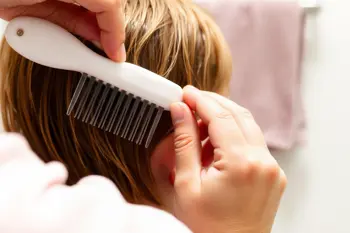
Wet combing is a non-drug method for removing lice and eggs. Wet the hair, apply conditioner, and separate it into manageable sections. Starting at the scalp, draw the fine-toothed comb through the hair to the ends, wiping the comb after each pass so removed material can be inspected and discarded. Because nits are attached firmly, ordinary shampooing, rinsing, or shaking the hair does not reliably remove them. 1 4
Combing must be repeated because a single session may miss eggs or newly hatched nymphs. Guidance commonly recommends combing every two to three days for two to three weeks after treatment, while wet-combing schedules may specify repeated sessions across a two-week period. The practical objective is to remove live lice before they mature and lay more eggs, while also clearing nits that remain attached to the hair. 1 6
Understand medication timing and limitations
Approved over-the-counter or clinician-recommended lice medicines can kill live lice, but some products do not kill the newest eggs. Product instructions therefore may require a second application, most often 7 to 10 days after the first. Permethrin and pyrethrin products are among the nonprescription options described by Mayo Clinic, with age restrictions and application directions that must be followed precisely. Only one lice-treatment medicine should be used at a time. 1 3
Medication should not be repeated more often than the label or a healthcare professional directs. Itching or mild scalp burning can continue for days after treatment and does not automatically prove that live lice remain. The more reliable follow-up measure is whether live lice are still found during careful checks. If live lice remain after the directions were followed correctly, medical advice is preferable to repeatedly applying the same product. 1 9
Handle household items without excessive cleaning
Head lice depend on a human scalp and do not survive long away from it. Household measures should focus on recently used items rather than attempting to disinfect an entire home. Clothing, bedding, pillowcases, and towels used during the two days before treatment can be washed in hot water and dried on a hot cycle. Items that cannot be washed can be sealed in a plastic bag for two weeks. 5 8
Floors and furniture where the affected person sat or lay can be vacuumed, but extensive deep-cleaning, discarding furniture, and insecticide fogging are unnecessary. Fumigant sprays and fogs can expose household members to toxic chemicals without providing a proportionate benefit. Human head lice do not live on pets, so dogs, cats, and other household animals do not require treatment for a human head-lice infestation. 2 8 10
Check household members and reduce spread
Head lice spread mainly through direct head-to-head contact, including close play, sports, sleepovers, and contact between siblings. Sharing hats, brushes, hair accessories, towels, pillows, or similar objects is a less common route. Once an infestation is confirmed, household members and other close contacts should be checked for live lice or nits close to the scalp. People with live lice may need coordinated treatment to reduce reinfestation. 2 3
- 避免 head-to-head contact while active lice are being managed. 2
- Do not share combs, brushes, hats, helmets, hair ribbons, or towels. 3
- Do not treat people who have no evidence of live lice unless a healthcare professional recommends it. 3
Avoid hazardous home remedies
Kerosene, gasoline, household pesticides, and surface fumigants should never be applied to hair or skin. These substances can cause poisoning, burns, breathing problems, or other serious injury and are not appropriate substitutes for established lice-management methods. Oils, mayonnaise, tea tree oil, and similar remedies may be inconsistent or irritating, and no natural method can reliably guarantee that every louse and egg will be removed in one day. 7 10
Heat from ordinary showers or hair washing should not be treated as a dependable way to kill attached eggs. Nits are protected by an outer casing and remain cemented to the hair shaft, which is why manual combing and correctly timed follow-up treatment are central to management. Scalp products can themselves cause itching or burning, so directions, age limits, and exposure precautions should be reviewed before use. 1 7
Know when medical advice is needed
Professional advice is appropriate when the diagnosis is uncertain, live lice continue after correct treatment, or the scalp shows signs of infection. Repeated treatment failure may reflect incorrect application, missed contacts, reinfestation, or reduced product effectiveness, and changing products should be guided by a healthcare professional rather than attempted through repeated unscheduled applications. Infants, pregnant people, and anyone with substantial scalp irritation require particular caution before using medication. 1 3
A practical home plan combines confirmation, wet combing, label-directed medication when indicated, and scheduled rechecks. Nits farther from the scalp are often old, dead, or empty, so treatment decisions should not rely on their presence alone. Continued monitoring over the following two to three weeks helps identify newly hatched lice and provides a clearer indication of whether the infestation has ended than visual concern about every remaining speck. 1 6
Sources
- Mayo Clinic
- Johns Hopkins Medicine
- Centers for Disease Control and Prevention
- HealthyChildren.org, American Academy of Pediatrics
- MedlinePlus, U.S. National Library of Medicine
- National Health Service
- Seattle Children’s Hospital
- Nemours KidsHealth
- American Academy of Dermatology
- Massachusetts Department of Public Health
Authored by MistyMountainView team