Home remedies for treating scalp conditions naturally: Evidence-based safety and limits
Home remedies for treating scalp conditions naturally can include soothing ingredients, careful washing, and measures intended to reduce irritation. However, dandruff, seborrheic dermatitis, psoriasis, folliculitis, ringworm, and head lice have different causes, so a kitchen-based remedy is not a universal treatment. 1
Identify the scalp condition before treating it
Dandruff commonly involves flaking and itching associated with scalp sensitivity, oil production, and the yeast Malassezia. Seborrheic dermatitis represents a more inflammatory condition that can produce flaky scale, redness, and persistent discomfort, and it may require antifungal treatment rather than moisturization alone. 5 9
Other conditions require different decisions. Scalp psoriasis may cause thick, silvery plaques, while folliculitis can appear as small red or white-headed bumps around hair follicles. Ringworm is a fungal infection that generally needs prescription oral antifungal medicine, and head lice require approved lice treatment with meticulous combing rather than household oils alone. 7 8
Tea tree oil has limited but relevant evidence
A randomized controlled trial found that a shampoo containing 5% tea tree oil improved dandruff severity compared with placebo after four weeks. This finding applies to a formulated shampoo, not automatically to concentrated essential oil applied directly to the scalp. Tea tree oil therefore has a narrower evidence base than many online home-remedy claims suggest. 3
Topical tea tree oil can cause irritation or allergic contact dermatitis, and it should not be swallowed. Undiluted essential oil may be especially problematic on scratched, inflamed, or sensitive skin. A cautious approach involves using a properly formulated product, following its directions, and stopping if burning, swelling, redness, itching, or a rash develops. 4
Soothing options such as aloe and honey
Aloe vera gel is described in the supplied research as a soothing and hydrating ingredient that may help calm inflammation and itching. It can be considered supportive care for an irritated scalp, but it does not address every cause of scaling. A persistent oily, red, or recurrent scalp problem may still involve Malassezia and require antifungal management. 5 9
Diluted honey has been studied in people with chronic dandruff and seborrheic dermatitis, with a small clinical study reporting reductions in itching and scaling when used regularly. The study conditions involved leaving the diluted honey in place considerably longer than a typical brief mask, so results should not be assumed to apply to every homemade mixture. 11
Why vinegar and oils require caution
Apple cider vinegar is frequently presented as a pH-balancing scalp rinse, but the supplied research states that good clinical research has not established it as an effective dandruff treatment. One study found that even diluted vinegar failed to improve the skin barrier and irritated most participants, while undiluted vinegar has caused chemical burns. It should not be applied to an inflamed, scratched, or sensitive scalp. 11
Coconut and other natural oils may temporarily soften scales or reduce the sensation of dryness, but they do not reliably treat the yeast-related inflammation associated with seborrheic dermatitis. Heavy oiling can also conflict with an oily scalp pattern. The distinction is important: temporary softening of flakes is not the same as treating the underlying inflammatory or infectious process. 1 5
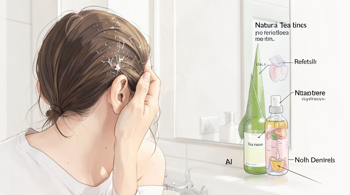
Everyday scalp-care measures
Gentle, consistent washing is a practical foundation for managing mild flaking. Dermatology guidance identifies medicated shampoos containing ketoconazole, selenium sulfide, zinc pyrithione, salicylic acid, sulfur, or coal tar as established options for dandruff control. These products are not natural remedies, but their inclusion is important because persistent dandruff may not respond adequately to botanical ingredients alone. 1 2
Scalp care should avoid aggressive scratching, very hot water, harsh fragrances, and repeated exposure to ingredients that cause stinging. For scalp psoriasis, loosening scales with salicylic-acid products or mineral oil before washing may make removal easier, but scratching can worsen inflammation and cause bleeding. A remedy that increases discomfort is a reason to discontinue it rather than intensify use. 1
Dietary and lifestyle considerations
Omega-3 supplements, including fish oil, are described in the supplied research as a possible source of internal anti-inflammatory support, while probiotics are discussed in relation to the gut-skin connection. These approaches should be viewed as supportive considerations, not established replacements for treatment of dandruff, seborrheic dermatitis, psoriasis, or infection. The available material does not establish a universal supplement dose or guaranteed outcome. 12
Stress reduction and attention to washing habits are also included among natural scalp-care strategies, because flare patterns can be affected by irritation, product buildup, and individual scalp sensitivity. Any supplement may have considerations related to health conditions, pregnancy, nursing, or medication use. Professional advice is appropriate before adding supplements or applying multiple new substances simultaneously. 12
When home care is not enough
Medical evaluation is warranted when dandruff is severe, the scalp is very itchy, or redness and swelling develop. Persistent pain, bleeding, sores, pus-filled bumps, marked swelling, or hair loss also raise the likelihood that a condition needs diagnosis rather than continued experimentation with home remedies. These signs can occur with inflammatory disease, folliculitis, or infection. 6 10
Scalp ringworm and head lice illustrate the limits of natural treatment particularly clearly. Ringworm generally requires prescription oral antifungal medicine because topical products alone do not adequately reach the infection. The Centers for Disease Control and Prevention recommends approved lice treatments and combing procedures instead of relying on unproven household remedies. Early evaluation can prevent prolonged symptoms and transmission. 7 8
Practical safety checklist
Natural does not mean risk-free. Botanical ingredients can trigger contact dermatitis, and concentrated essential oils can irritate skin or cause allergic reactions. Patch testing may identify some reactions, but it cannot guarantee that repeated scalp exposure will remain safe. Products should be kept away from the eyes and mouth, and every remedy should be stopped if a new rash, burning, swelling, or worsening itch appears. 4
- Do not use undiluted essential oils on the scalp. 4
- Do not treat suspected ringworm or lice solely with household oils. 7 8
- Do not apply vinegar to scratched or inflamed skin. 11
- Seek clinical assessment for persistent, painful, swollen, bleeding, intensely itchy, or hair-loss-associated symptoms. 6 10
Sources
- American Academy of Dermatology, Treating dandruff: https://www.aad.org/public/everyday-care/hair-scalp-care/scalp/treat-dandruff
- Mayo Clinic, Dandruff diagnosis and treatment: https://www.mayoclinic.org/diseases-conditions/dandruff/diagnosis-treatment/drc-20353854
- PubMed, Tea tree oil shampoo randomized controlled trial: https://pubmed.ncbi.nlm.nih.gov/12451368/
- National Center for Complementary and Integrative Health, Tea tree oil: https://www.nccih.nih.gov/health/tea-tree-oil
- Cleveland Clinic, Seborrheic dermatitis: https://my.clevelandclinic.org/health/diseases/14414-seborrheic-dermatitis
- National Health Service, Dandruff: https://www.nhs.uk/conditions/dandruff/
- American Academy of Dermatology, Scalp ringworm treatment: https://www.aad.org/public/diseases/a-z/ringworm-scalp-treatment
- Centers for Disease Control and Prevention, Head lice treatment: https://www.cdc.gov/lice/treatment/index.html
- DermNet, Seborrhoeic dermatitis: https://dermnetnz.org/topics/seborrhoeic-dermatitis
- MedlinePlus, Dandruff: https://medlineplus.gov/ency/article/000963.htm
- Organic And Herbal Solutions, Dandruff-free scalp naturally: https://organicandherbalsolutions.com/dandruff-free-scalp-naturally-five-science-supported-remedies-by-scalp-type/
- FactxTop, Natural treatments for dandruff: https://factxtop.com/10-natural-treatments-for-dandruff/
Authored by MistyMountainView team