Best music classes for seniors near me: A researched guide to local options
People searching for the “Best music classes for seniors near me” are generally looking for more than technical instruction. Local options may combine music education with social connection, including no-audition choirs, beginner guitar or ukulele groups, songwriting workshops, sing-alongs, and intergenerational sessions.
Availability, dates, age requirements, tuition, transportation, and accessibility vary significantly by community. The examples below illustrate established program formats and selection criteria, rather than representing a live directory of currently available classes.
Choirs and group singing
Choirs are among the clearest options for older adults who want structured music-making and regular social contact. Encore ROCKS San Diego is designed for adults aged 55 and older, requires no audition or previous musical experience, and uses rock and roll classics associated with artists including Paul Simon and Queen. Its listed Fall 2026 schedule is Wednesdays from 12:30 to 2:00 p.m. at First United Methodist Church of San Diego, with tuition of $190. 1
The Asheville Senior Chorus similarly emphasizes open participation across skill levels. Its weekly rehearsals are listed for Mondays from 6:15 to 8:15 p.m. at the OLLI/Reuter Center on the University of North Carolina at Asheville campus. The organization states that auditions have never been required, making this format potentially suitable for people who want an encouraging ensemble without performance-based screening. 2
Beginner guitar and ukulele classes
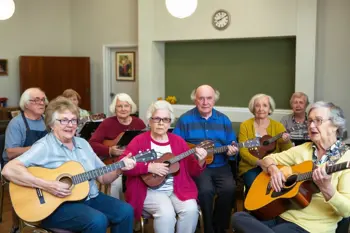
Beginner instrument classes tend to focus on practical skills rather than formal conservatory training. A senior group guitar class described by Creative Bridges Studios covers tuning, basic chords, strumming patterns, chord charts, simple songs, finger coordination, and playing with others. The stated pace is steady and easy to follow, accommodating both first-time players and people returning to an instrument after many years. 3
Ukulele programs may offer a similar pathway with a smaller instrument and a song-centered curriculum. Music for Seniors lists a six-week Nashville beginners’ Ukulele Learning Lab covering the instrument’s design, basic chords, strumming patterns, and familiar songs. The listed sessions build sequentially, and loaner ukuleles are available for students who need an instrument. The example venue is CenterWell Senior Primary Care in Bellevue, Nashville. 4
- Instruction commonly begins with posture, tuning, chords, and rhythm.
- Group practice can support timing, confidence, and regular attendance.
- Instrument availability should be verified before enrollment.
Recreation centers and community programs
Municipal recreation departments can provide music participation without the structure of a formal music school. “Music with Mark,” listed by Agoura Hills Recreation and Event Center, describes an hour featuring favorite songs, musicals, piano-bar material, sing-alongs, rock, and other styles. The listed program runs Thursdays from July 2 through September 24, 2026, at the center’s Lounge and is intended for ages 50 and older, with a 2026 senior membership prerequisite. 5
These programs may be more appropriate for music appreciation, participation, and social interaction than for progressive instrumental technique. Eligibility rules can differ even among nearby facilities. A senior membership, registration form, health-related accommodation, or specific age threshold may apply, so the program description should be checked for requirements before making travel arrangements.
Songwriting and creative music workshops
Songwriting workshops provide an alternative for people who prefer composing and storytelling to rehearsing an existing repertoire. Music for Seniors describes a two-hour workshop at Nashville Public Library in Madison led by Nashville-based country-rock artist Bobbi Berracah. The curriculum includes developing an idea, identifying a central direction, selecting a rhyme scheme, forming a hook, and producing a group-created song. The listed event is marked as having passed. 9
A second Music for Seniors listing places a comparable workshop at Nashville Public Library Hermitage and identifies the same instructor. It describes the session as intended for older adults and provides a two-hour schedule from 11:00 a.m. to 1:00 p.m. These listings demonstrate that libraries can host specialized music education, but dated event pages should not be treated as evidence that a session remains open or recurring. 10
Intergenerational and wellness-oriented formats
Some classes connect older adults with children and families rather than separating participants by age. All Newton Music School’s Intergenerational Music Group is open to all ages and combines singing, movement, and instrument play. The group is led by an early childhood specialist and a board-certified music therapist in partnership with the Cooper Center for Active Living in Newton, Massachusetts. The listed sessions occur monthly on Tuesdays from 11:00 a.m. to noon. 8
Music can also be part of a therapeutic or dementia-support setting, although therapy is not the same as a conventional lesson. Music & Memory focuses on personalized music engagement for people living with dementia and other older adults, while the American Music Therapy Association provides information about professional music therapy resources. Anyone seeking clinical support should distinguish a recreational class from services delivered by appropriately qualified practitioners. 12 13
How to compare nearby classes
Several national and community-based channels can help identify local possibilities. Osher Lifelong Learning Institutes provide noncredit classes and activities through colleges and universities for older adults. Lifetime Arts supports professionally led creative-aging programs, and the National Guild for Community Arts Education represents community arts and music education organizations. YMCA branches, libraries, senior centers, and parks-and-recreation departments are also common locations for group music activities. 11 14 15
Comparison should include more than the course title. Relevant questions concern daytime or evening scheduling, room access, seating, hearing support, group size, beginner expectations, transportation, instrument loans, make-up policies, registration obligations, and whether participation involves a public performance. The National Endowment for the Arts and National Institute on Aging identify arts participation and creative activity as relevant to healthy aging and social engagement, but individual outcomes vary and should not be treated as medical guarantees. 16 17
| Factor | What to verify |
|---|---|
| Instruction level | Beginner, returning player, mixed experience, or audition-based |
| Schedule | Day, evening, weekly, monthly, or limited-series format |
| Access | Venue location, seating, mobility access, hearing conditions, and transportation |
| Participation | Rehearsal only, informal sharing, or a scheduled showcase |
| Eligibility | Age range, membership, registration, fees, and instrument requirements |
Risks and practical limitations
Local music classes can involve logistical friction. A program may be held at a venue that is difficult to reach, scheduled outside a participant’s preferred hours, or designed for a pace that does not match individual needs. A listed class may also be seasonal, full, postponed, or already completed. Search results and event pages therefore require direct date, venue, eligibility, and registration verification rather than assumptions based on an older listing.
Health benefits should likewise be described carefully. Group singing, instrumental practice, and creative participation may support connection, enjoyment, memory engagement, or coordination, but they do not replace medical care or guarantee specific improvements. For people with hearing, respiratory, cognitive, or mobility concerns, an instructor, caregiver, senior center, or qualified clinician can help determine whether the room, workload, and format are suitable.
Sources
- San Diego Master Chorale, Encore ROCKS San Diego
- Asheville Senior Chorus, Sing With Us
- Creative Bridges Studios, Senior Group Guitar Class
- Music for Seniors, Ukulele Learning Lab Nashville
- Active.com, Music with Mark, Agoura Hills
- SOMA, Strum & Sing for Seniors
- Aging Ahead, OASIS Golden Beats
- All Newton Music School, Intergenerational Music Group
- Music for Seniors, Songwriting Workshop Madison
- Music for Seniors, Songwriting Workshop Hermitage
- Osher Lifelong Learning Institutes
- Music & Memory
- American Music Therapy Association
- Lifetime Arts
- National Guild for Community Arts Education
- National Endowment for the Arts
- National Institute on Aging
Authored by MistyMountainView team