Mental health residential programs in the United States: A data-informed guide to care, access, and oversight
Residential mental health programs in the United States provide 24/7 compassionate and structured support for adults whose symptoms interfere substantially with daily functioning. These live-in settings may address depression, anxiety, bipolar disorder, trauma, schizophrenia, and co-occurring substance use concerns through continuous supervision, therapy, psychiatric care, and individualized planning. 1
What residential mental health care means
Residential treatment is a high-intensity level of mental health care in which residents live in a structured therapeutic environment rather than attending only scheduled outpatient appointments. The setting is generally intended for people who need more support than outpatient therapy can provide but may be able to participate voluntarily in a non-hospital residential program. NAMI describes residential treatment as a 24/7 environment within the broader range of mental health care. 1
Program design varies considerably. Some facilities emphasize psychiatric stabilization and medication management, while others focus on trauma recovery, persistent mental illness, dual diagnosis, or skills for returning to community life. Reported stays may range from approximately 30 days to several months, depending on clinical needs, progress, insurance authorization, and discharge planning. 2
Services and daily clinical structure
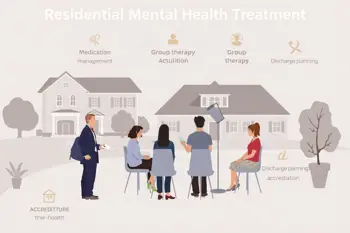
Common services include individual therapy, group therapy, psychiatric evaluation, medication management, nursing support, coping-skills training, life-skills development, and aftercare planning. Mayo Clinic identifies medical management and daily therapy as central components of residential psychiatric care. Programs may also incorporate mindfulness, expressive arts, equine activities, nutrition, or other wellness services, although availability and clinical relevance differ by facility. 2
- Individual sessions for personal treatment goals
- Group sessions for communication, emotional regulation, and peer learning
- Medication review and psychiatric monitoring
- Structured supervision throughout the day and night
- Discharge planning that may include PHP or IOP referrals
Examples in the research material illustrate this range. A 16-bed Minnesota IRTS program lists individual and group therapy, medication management, psychiatric and nursing support, life-skills work, and 24-hour staffing. Arizona programs describe CBT, EMDR, somatic approaches, and trauma-informed care, while a Kansas program reports using CBT, DBT, ACT, and measurement-based treatment. 345
Eligibility, fit, and clinical limitations
Residential care may be considered when symptoms impair daily functioning, outpatient treatment has not been sufficient, a recent psychiatric crisis has occurred, or a person cannot maintain stability in a less structured setting. Conditions named by representative programs include major depression, anxiety and panic disorders, bipolar disorder, PTSD, trauma-related symptoms, self-harm, and co-occurring substance use. Diagnosis alone does not establish eligibility. 36
Admission assessments commonly examine safety, medical and psychiatric needs, previous treatment, substance use, ability to participate, and whether the program’s environment matches the person’s needs. Austen Riggs describes admission as a conversation about fit for adults whose difficulties have often persisted despite serious prior treatment, emphasizing an open and voluntary setting. A residential program may be inappropriate when emergency hospitalization, medical detoxification, or a different specialized service is required. 7
Geographic and program variation
Residential programs operate in different clinical and physical environments across the country. The research examples include adult services in Pennsylvania, Arizona, Minnesota, Massachusetts, Florida, Utah, Kentucky, and Kansas. Some are small, home-like facilities, while others operate on larger campuses or within centers that also provide detoxification, addiction treatment, or outpatient services. Location can affect travel, family participation, licensing requirements, and continuity after discharge. 89
| Program characteristic | Examples in the research |
|---|---|
| Population | Adults 18 and older, with some programs serving all genders |
| Capacity | A 16-bed Minnesota program and a 15-bed Utah facility |
| Clinical focus | Primary mental health, trauma, co-occurring disorders, or psychiatric treatment |
| Setting | Urban or suburban sites, private campuses, and desert or home-style environments |
Specialization is an important distinction when comparing programs. Some facilities identify trauma-informed care, LGBTQ+ affirming services, eating-disorder treatment, dual diagnosis, or treatment-resistant depression as areas of focus. A program’s stated specialties should be compared with its licensed scope, staffing, crisis capability, medical services, and ability to manage the specific risks involved. 410
Costs, insurance, and market access
Residential mental health costs vary widely in the United States. The supplied research describes a broad private-care range of roughly $500 to $2,000 per day, influenced by clinical intensity, facility amenities, location, length of stay, and insurance arrangements. This range is a general category estimate rather than a current quote, and actual responsibility may depend on deductibles, copayments, coinsurance, exclusions, and authorization requirements. 11
The Mental Health Parity and Addiction Equity Act generally requires comparable financial and treatment limitations for mental health and medical benefits when a plan offers both, but parity does not mean every residential service is covered. Plans may apply medical-necessity criteria, network restrictions, utilization review, and length-of-stay decisions. Questions about coverage should address the exact level of care, authorization process, exclusions, and expected patient responsibility. 12
Oversight, quality signals, and transition planning
State licensing and external accreditation are important but distinct forms of oversight. State health departments may license facilities to operate, while The Joint Commission and CARF International provide accreditation frameworks for quality, safety, and behavioral health operations. Accreditation can be a useful quality signal, but it does not guarantee a particular clinical outcome, staffing experience, or fit for every resident. 1314
Transition planning is a central measure of program quality because residential care is not usually intended to replace ongoing community treatment. Step-down options can include partial hospitalization programs and intensive outpatient programs, followed by outpatient therapy, medication management, peer support, or other continuing services. Evaluation should examine crisis procedures, medication continuity, family involvement, discharge criteria, records transfer, transportation, and access to clinicians after departure. 15
Questions for evaluating a program
- Is the facility licensed for the advertised level of care?
- Which clinicians provide psychiatric, nursing, and therapeutic services?
- How are emergencies, self-harm risk, medical concerns, and substance use handled?
- What conditions and age groups are accepted or excluded?
- How are treatment goals measured and revised?
- What discharge supports are arranged before residential care ends?
Potential risks include separation from family and work, disruption of existing medical care, unexpected financial exposure, inconsistent quality between facilities, and a poor match between program capabilities and clinical needs. National directories such as SAMHSA’s treatment locator, state licensing records, accreditation information, and independent guidance from Mental Health America can support comparison without treating any single listing as an endorsement or guarantee. 1617
Sources
- NAMI, Types of Mental Health Treatment: https://www.nami.org/about-mental-illness/treating-mental-health-conditions/types-of-mental-health-treatment/
- Mayo Clinic, Residential Treatment: https://www.mayoclinic.org/tests-procedures/residential-treatment/about/pac-20384813
- Horowitz Health, The Landing 1: https://www.horowitzhealth.com/services/residential-treatment/landing-1/
- The Meadows, Inpatient Mental Health Treatment: https://www.themeadows.com/locations/the-meadows/inpatient-mental-health-treatment/
- Discovery Mood & Anxiety Program, Shawnee Residential: https://discoverymood.com/locations/shawnee-residential/
- Recovery Centers of America at Devon, Residential Mental Health Treatment: https://recoverycentersofamerica.com/locations/devon/mental-health/
- Austen Riggs Center, Admission: https://www.austenriggs.org/admission
- Palm City Wellness, Inpatient Mental Health Treatment: https://palmcitywellness.com/
- Corner Canyon Health Centers, Residential Mental Health Treatment: https://cornercanyonhc.com/
- Legacy Recovery Center, Residential Mental Health Treatment in Arizona: https://www.legacyrecoverycenter.com/residential-mental-health-treatment-in-arizona/
- Healthline, Residential Treatment Center Costs: https://www.healthline.com/health/mental-health/residential-treatment-centers
- CMS, Mental Health Parity and Addiction Equity Act Factsheet: https://www.cms.gov/CCIIO/Programs-and-Initiatives/Other-Insurance-Protections/mhpaea_factsheet
- The Joint Commission: https://www.jointcommission.org/
- CARF International: https://www.carf.org/home/
- American Psychological Association, Mental Health Help: https://www.apa.org/topics/mental-health/help
- SAMHSA, FindTreatment.gov: https://findtreatment.gov/
- Mental Health America, Finding Help: https://mhanational.org/finding-help
Authored by MistyMountainView team