Ways to manage vertigo at home: Evidence-based safety guidance
Ways to manage vertigo at home starts with recognizing that vertigo is a symptom rather than a single disease. It describes a false sensation that a person or the surroundings are spinning, and treatment depends on the underlying cause, which may include an inner-ear disorder, migraine, medication effects, or a neurological condition. 1
Identify the pattern before treating it
Brief spinning episodes triggered by rolling in bed, lying down, bending over, or turning the head are consistent with a common inner-ear problem called benign paroxysmal positional vertigo, or BPPV. BPPV occurs when tiny calcium crystals move into a semicircular canal and send incorrect motion signals to the brain. Symptoms often last up to about one minute, although nausea and vomiting may also occur. 3
Not every spinning sensation is BPPV. Vertigo can also arise from vestibular neuritis, labyrinthitis, Meniere’s disease, migraine, head injury, or other balance-system problems. Persistent, recurrent, severe, or unexplained symptoms should therefore be assessed by a healthcare professional rather than treated indefinitely with home exercises. Diagnosis may involve head-position testing, eye-movement assessment, hearing or balance tests, or imaging when another cause must be ruled out. 4
What to do during an episode
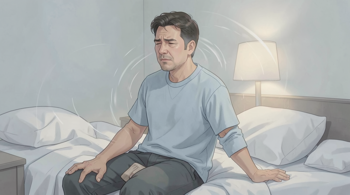
During active vertigo, sitting or lying still in a quiet, dark room can reduce movement and visual stimulation. Sudden head movements should be avoided, and changing position slowly may lessen the risk of worsening symptoms. When getting out of bed, a safer sequence is to sit first, pause, and then stand while using a stable support if balance remains impaired. 5
Hazardous activities should be avoided until spinning and balance problems have resolved. Driving, climbing, operating machinery, bathing without appropriate support, and walking on uneven surfaces can increase injury risk. Hydration may be helpful, while alcohol can worsen balance or symptoms and is best limited. Medicines for nausea or dizziness may be prescribed or recommended by a clinician or pharmacist, but drowsiness and impaired coordination are important possible effects. 7
Reduce falls in the home
Vertigo can make ordinary movement unsafe, particularly when symptoms begin without warning. Practical fall-prevention measures include improving lighting, clearing clutter from walkways, removing loose rugs, keeping frequently used items within easy reach, and installing grab bars where needed. A cane, handrail, or another suitable support may help some people, but assistance should be used carefully because unstable furniture is not a reliable handhold. 9
Balance impairment can continue briefly after the spinning sensation has eased. Moving slowly, keeping pathways clear, and asking another person to remain nearby during severe episodes can reduce exposure to hazards. Anyone who has fallen, cannot walk safely, or repeatedly needs support should seek medical advice. Ongoing balance disorders may cause unsteadiness and falls, making evaluation important even when individual episodes seem temporary. 11
When the Epley maneuver may help
The home Epley maneuver is designed for BPPV, not for every cause of vertigo. It uses a sequence of head and body positions intended to move displaced canaliths out of a semicircular canal and back toward the utricle, where they normally belong. The maneuver is most appropriate after a healthcare professional has confirmed the likely affected side and demonstrated the correct technique. 3
Although the Epley maneuver is often effective for BPPV, it can temporarily intensify spinning and may be unsafe for people with certain neck or back problems, vascular disease, or other conditions that make positional movements risky. It should not be improvised from an uncertain diagnosis. Johns Hopkins describes the home procedure as similar to the clinician-performed sequence, while Cleveland Clinic reports symptom relief in about eight out of ten people. 11
Exercises, rest, and treatment limits
Brandt-Daroff exercises are another home-based option used for BPPV. An NHS hospital information sheet describes them as repeated movements performed with a bed and reports reduced dizziness for about 95 out of 100 people when performed correctly. The same guidance describes a schedule of three sessions each day, with five repetitions per session, and states that complete relief commonly occurs after 30 days. 10
Exercises should be selected according to the diagnosed condition and individual safety considerations. Repeatedly provoking dizziness without instruction can increase fall risk and may delay evaluation of another disorder. Medication can relieve nausea or dizziness temporarily, but it does not correct the displaced crystals responsible for BPPV and may cause sedation. Treatment plans may instead include repositioning procedures, medication, or balance therapy depending on the cause. 4
When urgent medical care is necessary
Vertigo accompanied by trouble speaking, facial drooping, weakness or numbness in an arm or leg, double vision, sudden vision changes, severe headache, fainting, chest pain, or major difficulty walking requires emergency assessment. Sudden dizziness or loss of balance can occur among stroke warning signs, especially when combined with neurological symptoms. These symptoms should not be attributed to an inner-ear problem without medical evaluation. 6
Emergency evaluation is also appropriate when symptoms are new, unusually severe, follow a head injury, or prevent safe hydration and walking. For less urgent situations, a healthcare appointment is warranted when episodes persist, recur, affect hearing, or interfere with daily activities. A clinician can distinguish BPPV from other vestibular or neurological conditions and determine whether a home maneuver, medication, rehabilitation, or additional testing is appropriate. 1
Sources
- Cleveland Clinic, “Got Vertigo? Try These Home Remedies”
- WebMD, “Home Remedies for Vertigo”
- Johns Hopkins Medicine, “Home Epley Maneuver”
- Mayo Clinic, “Benign paroxysmal positional vertigo: Diagnosis and treatment”
- NHS, “Vertigo”
- Centers for Disease Control and Prevention, “Signs and Symptoms of Stroke”
- MedlinePlus, “Vertigo”
- Merck Manual, “Dizziness and Vertigo”
- National Institute on Deafness and Other Communication Disorders, “Balance Disorders”
- The Rotherham NHS Foundation Trust, “Home treatment of BPPV”
- Cleveland Clinic, “Epley Maneuver”
Authored by MistyMountainView team