Train journeys across the American Southwest: An analysis of regional rail corridors and scenic connectivity
Train journeys across the American Southwest represent a distinctive mode of transport that balances regional history with modern transit requirements. Navigating the arid plains, high-altitude mountain passes, and iconic red rock formations of the desert, these rail corridors offer a perspective on the landscape that differs significantly from traditional road-based travel 1. As regional rail infrastructure continues to evolve, travelers have observed shifts in how accessibility to national parks and gateway towns is managed through rail-based service options 2.
Emerging Luxury and Scenic Transit Corridors
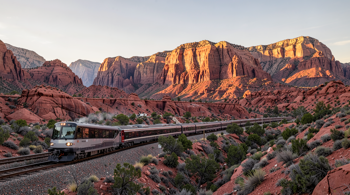
The recent introduction of the Canyon Spirit rail service, operating between Denver and Salt Lake City, underscores a growing interest in daylight-only scenic transit. This route, which utilizes reimagined freight corridors, specifically targets the traversal of rugged canyons such as Colorado’s Burns Canyon 1. Unlike historical rail lines developed in the late 19th century primarily for coal and industrial goods transport, this modern service focuses on the passenger experience of the shifting topography, from granite mountain ranges to soft sedimentary mesas 2. The operational focus remains on providing uninterrupted views, allowing passengers to view the American West as a continuous landscape rather than a sequence of fragmented stops 1.
Operational Logistics and Historical Context
Rail lines in the American Southwest were historically engineered for efficiency to navigate difficult mountainous terrain rather than circumventing it 1. The Denver and Rio Grande routes, dating back to the 1870s, established the foundation for much of the connectivity seen today, linking remote mining regions to urban centers 1. These tracks present unique operational challenges, including sharp elevation changes and narrow mountain passes, which dictate the speed and frequency of transit 3. Modern service providers must maintain these aging but essential corridors to support both heritage-focused tourism and regional passenger movement 4.
Long-Distance Amtrak Routes and Regional Access
Amtrak manages several long-distance routes that serve as the backbone of passenger rail in the Southwest. The Southwest Chief, for instance, spans the distance between Chicago and Los Angeles, crossing eight states and navigating the historically significant Santa Fe Trail corridor 6. This route is notable for passing through the Raton Pass in the Sangre de Cristo Mountains, a region where passengers experience dramatic shifts in geology from Great Plains farmland to narrow canyons 8. Simultaneously, the Sunset Limited provides a southern transit path, connecting New Orleans to Los Angeles via the desert environments of Texas, Arizona, and California 7.
Comparative Service Characteristics
| Route | Primary Geography | Duration Estimate |
|---|---|---|
| Southwest Chief | Chicago to Los Angeles | ~43 hours |
| Sunset Limited | New Orleans to Los Angeles | ~46-48 hours |
| Canyon Spirit | Denver to Salt Lake City | 3 days (inclusive of stops) |
Each of these services offers distinct passenger accommodations, including sleeper rooms and access to observation cars, which remain a standard feature for those undertaking multi-day travel through desert landscapes 7. The selection of specific routes often depends on the traveler's interest in either heritage rail experiences or transcontinental connectivity, with different lines offering varying degrees of access to iconic landmarks like the Grand Canyon 8.
Environmental and Navigational Realities
Rail travel in the American Southwest is subject to the inherent environmental pressures of the high desert and mountain climates. Infrastructure maintenance is a significant, ongoing reality, particularly for routes that traverse remote regions where tracks are starved of urban traffic support 4. Furthermore, these journeys are characterized by a unique pace, where train speeds often average around 35 miles per hour to accommodate the rugged terrain 3. This slower speed is a defining feature of the experience, enabling the observation of endemic wildlife and distinct geological transitions that are frequently missed by higher-speed alternatives or conventional highway driving 3.
Integration with Regional Tourism
The integration of rail with national park access has become a focal point for regional tourism strategies. For example, the expansion of the Canyon Spirit itinerary to include stops in Moab provides a direct gateway to Arches National Park, significantly altering how visitors approach park boundaries 2. Similarly, heritage services such as the Grand Canyon Railway offer specialized, short-haul tourism models that prioritize local geography and wildlife education 5. These services rely on the narrative of the landscape, often employing specialized guides to interpret the history of the regions being traversed, from the Sangre de Cristo Mountains to the Mojave Desert 3.
Regulatory Oversight and Maintenance
All rail operations in the American Southwest must navigate a complex landscape of regulatory and safety oversight. Because many of these lines overlap with active freight networks, passenger services must coordinate extensively with freight operators to ensure schedule reliability and track maintenance 1. The viability of these routes is further influenced by the availability of specialized rail staff, the historical integrity of the tracks, and the ongoing need to balance high-volume tourist demand with the constraints of aging infrastructure. Travelers should anticipate that schedules are subject to change and that operational delays, while mitigated by modern coordination, remain a structural factor in long-distance rail transit 6.
Authored by MistyMountainView team