Signs you may have magnesium deficiency: A Comprehensive Clinical Overview
Understanding the signs of magnesium deficiency requires looking past common labels and toward the fundamental biochemical roles this mineral plays within human physiology. While often overlooked, magnesium is involved in over 300 enzyme systems, supporting everything from muscle contraction and nerve signaling to blood glucose regulation and bone structure 7, 8. When systemic levels fall below the required threshold, the body may initiate a cascade of warning signs that are frequently misattributed to stress, fatigue, or general lifestyle habits 6, 10.
Early Manifestations of Low Magnesium
Initial signs of a magnesium deficit are notoriously subtle and often non-specific, leading many individuals to overlook them during early stages. Clinicians frequently observe symptoms such as a lack of appetite, generalized nausea, vomiting, persistent fatigue, and unexplained weakness 1, 8. These early-stage indicators can be easily mistaken for other health concerns, including thyroid irregularities or anemia, making them difficult to diagnose without a formal medical evaluation 7.
Beyond general physical malaise, individuals may experience a sense of being perpetually run down or physically heavy, even after adequate sleep 9. Because the body possesses safety mechanisms to maintain magnesium balance by reducing renal excretion when intake is low, a short-term drop in dietary magnesium rarely results in immediate, obvious symptoms 7. Instead, these early signs typically manifest when stores have been depleted over a more prolonged period, often compounded by lifestyle or dietary factors 2, 7.
Neuromuscular and Muscular Symptoms
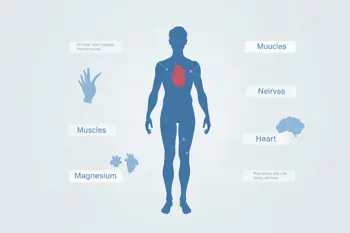
As magnesium levels drop further, the body often expresses its need through the neuromuscular system. Muscle cramps, particularly those occurring as nighttime leg cramps, are among the most common complaints reported by patients 9. This occurs because magnesium plays a critical role in allowing muscles to relax between contractions; when levels are insufficient, the muscles may remain in a state of increased irritability, leading to involuntary twitches, spasms, or tremors 1, 5, 9.
In addition to cramping, individuals may report sensations of numbness or tingling in the hands and feet, known clinically as paresthesia 8. These sensations are a direct reflection of nerve cell irritability caused by the disruption of normal ion transport, for which magnesium is essential 1, 3. In more pronounced cases, this neuromuscular excitability can progress to tetany, which is characterized by sustained muscle spasms in the extremities 8.
Cardiac and Severe Physiological Impacts
The most serious outcomes of significant hypomagnesemia involve the cardiovascular and central nervous systems. Magnesium is vital for maintaining a steady heart rhythm, and deficiency can manifest as palpitations or more dangerous arrhythmias, including conditions such as torsade de pointes 5, 8. These cardiac events are often considered medical emergencies and require immediate professional attention to stabilize heart function and restore electrolyte balance 3, 5.
Severe depletion may also affect cognitive and neurological stability, leading to personality changes, delirium, and, in critical instances, generalized tonic-clonic seizures 8. Such extreme symptoms represent a dangerous state of total body magnesium depletion, often associated with deep-seated issues like chronic alcoholism, severe malabsorption disorders, or prolonged use of specific pharmaceutical agents 5, 8. In these environments, clinical intervention is essential to prevent secondary complications like life-threatening cardiac arrest 5.
Contributing Risk Factors and Health Correlations
While true clinical deficiency is relatively rare in healthy, well-nourished adults, certain subpopulations face an elevated risk of developing hypomagnesemia 2. These risk groups often have underlying medical conditions that prevent the proper absorption or retention of the mineral, such as gastrointestinal diseases, Crohn’s disease, or surgical procedures that involve the small intestine 2, 10. Furthermore, individuals with uncontrolled type 2 diabetes or those struggling with heavy alcohol use disorder frequently exhibit lower magnesium stores due to increased renal excretion 2, 5.
Medications can also serve as a significant driver of magnesium loss. Common prescriptions, including proton-pump inhibitors (PPIs) used for acid reflux and various diuretic medications, are known to deplete the body’s magnesium reserves over time 5, 8. It is also important to note that magnesium deficiency rarely occurs in isolation; it is often observed alongside low levels of other essential electrolytes, specifically potassium and calcium, which can exacerbate the physical symptoms observed by the patient 5, 8.
Diagnostic Challenges in Clinical Practice
Diagnosing magnesium deficiency presents a unique challenge for healthcare providers because standard blood tests often fail to reflect total body status. Serum magnesium levels represent only about 1% of the total magnesium found in the body, as the vast majority of the mineral is stored within cells and bone tissue 8, 10. Consequently, a patient may exhibit symptoms of deficiency despite having serum magnesium levels that fall within the low-normal range, necessitating a reliance on clinical history and symptom evaluation rather than blood testing alone 8.
Because the signs of low magnesium overlap with numerous other nutritional and medical disorders, a physician must perform a differential diagnosis to rule out issues like anemia or metabolic syndrome 7. When a deficiency is suspected, a clinical approach typically involves reviewing medication lists, assessing dietary habits, and checking for secondary electrolyte imbalances 3. In institutional settings, where deficiency is more prevalent, clinicians may use intravenous magnesium salts to treat acute, symptomatic hypomagnesemia effectively 5.
Management and General Health Maintenance
Managing magnesium levels primarily involves addressing the root cause of the deficiency, whether that is dietary insufficiency or an underlying condition that disrupts absorption. For the majority of the population, meeting magnesium needs is possible through a balanced diet rich in nuts, seeds, legumes, leafy green vegetables, and whole grains 3. Because many refined, processed foods have their mineral content stripped away, prioritizing nutrient-dense whole foods is a common recommendation for improving intake 2.
When diet is insufficient, or when medical conditions prevent proper intake, professional guidance is required to determine the necessity and safety of supplementation 3. Supplements are not considered a universal solution and can interact with various medications or cause gastrointestinal side effects in some individuals 3. Patients are encouraged to work with healthcare providers to interpret symptoms accurately and develop a management plan that accounts for individual health history and ongoing nutritional requirements 2.
Sources
- Acibadem Hospitals Group: Low Magnesium Symptoms: Causes, Signs, And Care
- Prevention: 11 Subtle Symptoms of Low Magnesium Dietitians Want You to Know
- Acibadem Hospitals Group: Magnesium: Benefits, Deficiency, And Safe Use
- Lake Country Medical Group: Magnesium Deficiency: Signs, Symptoms, and Why So Many Adults May Be Low
- Wikipedia: Magnesium deficiency
- Healthpage.co.uk: Early Signs of Magnesium Deficiency: Symptoms & What to Watch For
- Times of India: Feeling tired or getting frequent muscle cramps? Here’s what low magnesium levels may signal
- Welltica: Low on magnesium? 8 signs your body may be trying to tell you
- oladoc: Magnesium Deficiency Symptoms: Signs, Causes & Best Foods
- Times of India: Magnesium deficiency is easy to overlook: What happens when your body doesn’t get enough
Authored by MistyMountainView team